

The Great Dissolving Debate: PVA Bags vs. PVA String
In the world of modern carp fishing, Polyvinyl Alcohol (PVA) is arguably the most significant advancement since the hair rig. It allows anglers to present free offerings with pinpoint accuracy right next to the hookbait.
However, the “Bag vs. String” debate is a common one. Both have distinct advantages, specific rig requirements, and optimal times for use. This guide will break down the mechanics, the setups, and the strategies for both.
What is PVA? The Science and The Types
PVA is a water-soluble synthetic polymer. In fishing, it is produced as a film (bags), a woven mesh, or a twisted strand (string). When it contacts water, it breaks down, leaving your bait perfectly positioned.
Understanding the grade of PVA is crucial.
Fast-Melt: Designed for winter or shallow water; dissolves rapidly in cold temperatures.
Slow-Melt: Designed for summer, deep water, or warm climates to ensure the bait reaches the bottom before the PVA dissolves.
Product Spotlight: Universal PVA Mesh System
To understand the baseline of quality PVA, look for specifications that offer versatility.
Product: Hydro-Link 4-Season PVA Mesh System
Description:
The Hydro-Link System is designed for the angler who demands reliability across all four seasons. Constructed from a high-grade, anti-ladder weave, this mesh creates compact sticks that explode effectively on the lakebed. It features a controlled breakdown time to ensure your rig settles perfectly before the bait is released. Ideal for creating “sticks” to mask the hook point or small parcels of pellets.
Specifications:
Material: High-grade, anti-ladder Polyvinyl Alcohol weave.
Diameter Options: Narrow (25mm) for distance casting; Wide (35mm) for larger bait parcels.
Breakdown Time: 45 seconds at 8°C (Winter); 20 seconds at 20°C (Summer).
Residue: Zero-residue finish; completely eco-friendly and biodegradable.
Includes: Plunger, loading tube, and 7m of refill mesh.
Uses: Stick mixes, crushed boilies, maggots (if coated in rock dust/maize flour).
Contender 1: The Solid PVA Bag
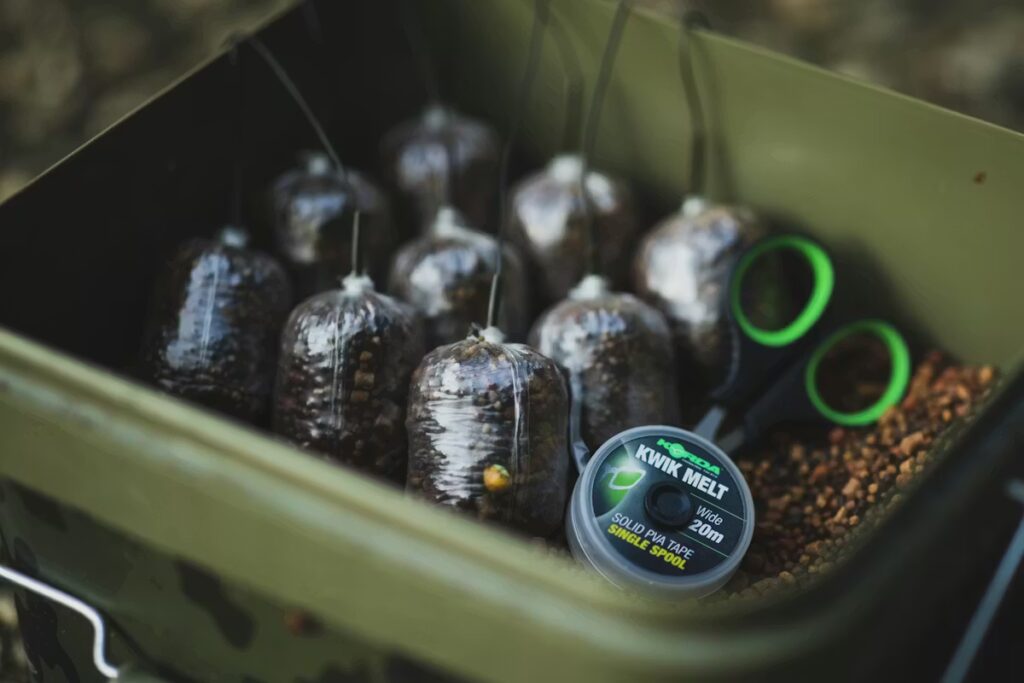
Solid PVA bags are sheets of PVA film sealed at the bottom. They are aerodynamic and designed to encapsulate the entire terminal tackle—lead, hooklink, and bait.
How to Set Up a Good PVA Bag
The goal is a “brick”—a solid, air-tight package that casts like a bullet.
The Base: Pour a small layer of pellets (2mm or 4mm) into the bag.
The Rig: Place your hookbait and hook into the bag on top of the pellets. Ensure the hook point is not masked by a piece of bait, though the pellets will protect it.
The Lead: Drop your inline lead in.
The Fill: Fill the rest with pellets/powder.
Compression: Squeeze the bag to remove air (essential for sinking). Twist the top, lick the PVA, and stick it down over itself. Tip: Poke the corners with a baiting needle to release trapped air.
Best Rigs for PVA Bags
The best rig for a solid bag is short and supple. Because the fish encounters the lead almost immediately inside the bag of food, you want instant hooking potential.
Length: 3 to 4 inches.
Material: Uncoated, soft braid. This coils up nicely inside the bag without kinking.
Lead System: Drop-off Inline leads are essential. The lead fits inside the bag, and the swivel pulls out easily.
Product Spotlight: Solid PVA Bags
When choosing bags, you want strength during the cast but a fast melt on the bottom.
Product: Aero-Glide Solid PVA Bags (Fast Melt)
Description:
Engineered for distance casting and rapid bait delivery, Aero-Glide bags feature a textured finish to prevent the sides from sticking together during loading. These bags are exceptionally strong, capable of withstanding high-impact casts, yet dissolve within roughly 60 seconds in average water temperatures. Perfect for encapsulating the entire rig to fish in weed or silt.
Specifications:
Film Thickness: Ultra-thin micron count for rapid dissolution.
Texture: Anti-static, embossed non-stick finish.
Sizes: Mini (55mm x 100mm), Standard (70mm x 110mm), Large (85mm x 160mm).
Seam Strength: Double-welded seams to prevent splitting on impact.
Oil Resistance: Compatible with all PVA-friendly oils and boosters.
Uses: Full rig encapsulation, liquid-heavy bag mixes, fishing over heavy weed.
Contender 2: PVA String
PVA String is a woven, soluble thread. It is primarily used to create “stringers”—a line of boilies threaded onto the string and attached to the hook.
How to Set Up a PVA Stringer
Spacing: Use a baiting needle to thread 3 to 6 boilies onto the string. Crucial: Leave a small gap (2mm) between each boilie. If they are too tight, the water cannot get between them to melt the string, and you will reel in a line of undissolved paste.
Attachment: Tie the string to the bend of the hook or the quick-change clip.
Tangle Prevention: Tying a small 2-bait stringer to the hook bend adds weight to the hook, helping to pull the hooklink straight during the cast, acting as an anti-tangle mechanism.
Best Rigs for PVA String
Unlike bags, stringers generally leave the hooklink exposed during the cast.
Length: Standard lengths (6 to 9 inches).
Material: Coated braid or Fluorocarbon. Since the rig isn’t coiled in a bag, you need stiffer materials to reset the rig if a fish disturbs it.
Rig Type: Blowback rigs or Snowman rigs work excellently with stringers.
Product Spotlight: Heavy Duty PVA String
You need a string that won’t snap on the cast but doesn’t leave a gloopy residue on the hook.
Product: Braided Dissolving PVA String (High Tensile)
Description:
A multi-strand, braided PVA string designed for high tensile strength. Unlike simple twisted tapes, this braided structure grips the boilies effectively, preventing them from sliding during the cast. It offers a medium breakdown time, ensuring your free offerings are settled on the lakebed before releasing. It is robust enough to cast heavy 20mm boilie stringers at range.
Specifications:
Structure: 6-ply braided weave.
Strength: High knot strength; allows for tight knotting without snapping.
Dissolve Rate: Medium-Fast (approx. 90 seconds in 15°C water).
Spool Length: 20 meters.
Shape: Flat profile to grip the bait internal channel.
Uses: Stringers, tying off solid bags, securing hair rigs during the cast.
Situational Tactics: Which is Best?
Choosing between a bag and a string depends on the lakebed, the season, and the behaviour of the fish.
1. Fishing in Weed
Winner: Solid PVA Bag.
Why: A solid bag protects the hook point. You can cast into thick silkweed, and the bag will rest on top. As it melts, the rig settles gently on the weed rather than getting snagged instantly. A stringer leaves the hook exposed, risking it catching weed on the way down.
2. Winter Fishing
Winner: Solid PVA Bag (Small/Mini).
Why: In winter, fish don’t move much. You want a tiny parcel of highly attractive food (powders/liquids) right next to the hook. A bag concentrates the feed. A stringer spreads the feed out too much for lethargic winter carp.
3. Summer/Big Pit Fishing
Winner: PVA String.
Why: In summer, fish are active and moving. A stringer spreads boilies over a slightly wider area (as they settle), encouraging the fish to move and feed aggressively, which often leads to better hook holds. Stringers are also much faster to tie and cast during a heavy feeding spell.
4. Distance Casting
Winner: Solid PVA Bag.
Why: While it adds weight, a compacted solid bag is aerodynamic. More importantly, it prevents the “helicoptering” of the lead and bait that kills distance.
Summary Comparison Table
| Feature | Solid PVA Bag | PVA String |
| Bait Type | Pellets, Powders, Liquids, Maggots | Boilies (Round baits) |
| Weed Presentation | Excellent (Protects hook) | Poor (Hook exposed) |
| Setup Speed | Slow (3-5 mins) | Fast (30 secs) |
| Aerodynamics | Excellent (if compacted) | Moderate |
| Best Season | Winter / Spring | Summer / Autumn |
| Cost | Higher per cast | Very Low |
Conclusion
If you are fishing a water with an unknown bottom or heavy weed, the Solid PVA Bag is your safety net; it guarantees your rig is fishing 100% of the time.
However, if you are fishing over a clean, hard bottom (gravel or clay) and want to apply a spread of boilies to get the fish moving, the PVA Stringer is a faster, more efficient tactic.