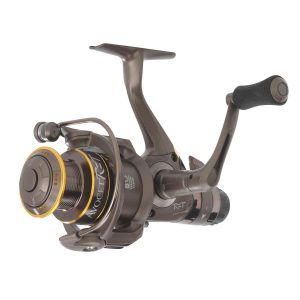
Rear Drag Coarse Reels: The Ultimate Guide to Control & Precision
By Gerry’s Fishing – Morecambe’s Independent Angling Experts Since 1980
Welcome to the Gerry’s Fishing Rear Drag Reel department. While front drag reels have become a modern standard, the Rear Drag (RD) reel remains the first choice for thousands of UK anglers. Why? Because it offers a level of ergonomic convenience that front-mounted systems simply cannot match. When you are in the heat of a battle with a hard-fighting tench or a commercial carp, being able to adjust your clutch at the back of the reel—without your hand ever crossing the path of the line—is a game-changer.
In 2026, rear drag technology has been refined by brands like Shimano and Abu Garcia, incorporating high-tech materials like XT-7 carbon to keep the weight down while maintaining that classic, balanced feel. At Gerry’s, we stock a curated range of rear drag reels, from the legendary Stradic GTM to the budget-friendly Sienna RE, ensuring every angler finds their perfect match.
The Rear Drag Advantage: Why Anglers Stay Loyal
The debate between front and rear drag often comes down to personal preference, but for the coarse angler, the rear drag offers three distinct “Pros”:
-
Safety & Accessibility: The adjustment knob is located at the base of the reel. This means you can tweak the tension mid-fight with your thumb and forefinger without reaching over the spool, reducing the risk of your hand tangling with the line or the bail arm.
-
The “Fighting Drag” System: A feature almost exclusive to Shimano rear drag reels. It allows you to set your primary drag tension and then use a secondary lever to instantly increase or decrease pressure by roughly 25%. It’s the ultimate “safety net” for the final moments at the net.
-
Balance on Long Rods: Rear drag reels naturally sit slightly further back in terms of weight distribution, which can help balance longer 13ft or 14ft float rods, making them feel less “tip-heavy” during a long day of trotting.
Featured Technology: The Shimano “Fightin’ Drag”
At Gerry’s, our most popular rear drag reels feature the Shimano Fightin’ Drag. This system is perfect for:
-
The Strike: Keep the lever in the middle for a standard hook-set.
-
The Run: Flick the lever to the left to instantly loosen the drag if a fish makes a sudden “bolt.”
-
The Net: Flick the lever to the right to tighten up when you need to guide a tired fish over the rim of the landing net.
Types of Rear Drag Reels at Gerry’s Fishing
1. Match & Float Specialist (3000 Size)
The most common use for rear drag reels. These are designed with high gear ratios (often 5.8:1 or higher) to retrieve line rapidly.
-
Top Picks: Shimano Sahara RD, Shimano Stradic GTM-RC.
-
Best For: Silverfish, river trotting, and light waggler work.
2. All-Rounder / Light Feeder (4000 Size)
A larger spool diameter reduces line twist and increases casting distance. These are robust enough for light legering on lakes or rivers.
-
Top Picks: Shimano Catana RE, Abu Garcia Cardinal.
-
Best For: Bream, Tench, and small Carp on the bomb or feeder.
3. Closed-Face Reels
A unique subset of the rear drag family. These “under-slung” reels are a favourite for river anglers because they allow for one-handed operation and prevent line from blowing off the spool in windy conditions.
Gerry’s Buying Guide: Selecting a Rear Drag Reel
1. Consider the Spool Depth
Many rear drag match reels come with Shallow Spools (marked as ‘S’). These are brilliant for coarse fishing as they don’t require hundreds of meters of “backing” line, which can save you money and reduce the weight of the setup.
2. Double Handle vs. Single Handle
-
Double Handle: Provides perfect balance and prevents the reel from “wobbling” during high-speed retrieval. This is a staple of the Shimano GTM series.
-
Single Handle: Offers more “cranking power” and is often preferred by those targeting slightly larger fish like barbel or tench.
3. Gear Ratio
Because rear drag reels are often used for float fishing, a higher gear ratio (e.g., 6.0:1) is advantageous. It allows you to retrieve your float quickly for another cast, maximizing your time with bait in the water.
Technical Specifications Table: Rear Drag Favourites
| Model |
Size |
Weight |
Gear Ratio |
Line Retrieve |
Features |
| Shimano Stradic GTM |
3000 |
310g |
5.8:1 |
92cm |
Fightin’ Drag, Double Handle |
| Shimano Sahara RD |
2500 |
275g |
5.2:1 |
76cm |
Fightin’ Drag, XT-7 Body |
| Shimano Sienna RE |
4000 |
365g |
5.1:1 |
82cm |
Budget Friendly, Varispeed II |
| Abu Garcia 506 MKII |
N/A |
288g |
3.9:1 |
65cm |
Closed-face, Synchro Drag |
Frequently Asked Questions (FAQ)
Q: Are rear drag reels less powerful than front drag?
A: Mechanically, yes. Because the drag washers in a rear drag reel are smaller (housed in the body rather than the spool), they don’t have the same “stopping power” as a front drag. However, for 95% of coarse fishing scenarios, they are more than powerful enough.
Q: Why are they so popular for river fishing?
A: When trotting a float, you often need to make very quick adjustments to the line tension. The rear position of the knob makes this intuitive and fast, allowing you to react to the flow of the river or a sudden bite.
Q: Can I use braid on a rear drag reel?
A: You can, but it is not always recommended for older models. Most rear drag reels are designed for Monofilament lines. If you plan to use braid, look for a modern model with an AR-C spool to prevent wind-knots.
Q: How do I change the spool on a rear drag reel?
A: This is one of the best features! Most rear drag reels have a “push-button” release in the centre of the spool. You can swap spools in seconds without touching your drag settings.
Why Buy From Gerry’s Fishing?
We understand the nuances of UK coarse fishing. We know that a “Fighting Drag” isn’t just a gimmick—it’s a tool that helps you land more fish.
-
Authorised Shimano Service: We stock the full range of Shimano spares.
-
Expert Setup: Not sure which line to pair with your RD reel? Our team can spool it for you before it leaves the shop.
-
Free Shipping: Available on many of our premium reel models