

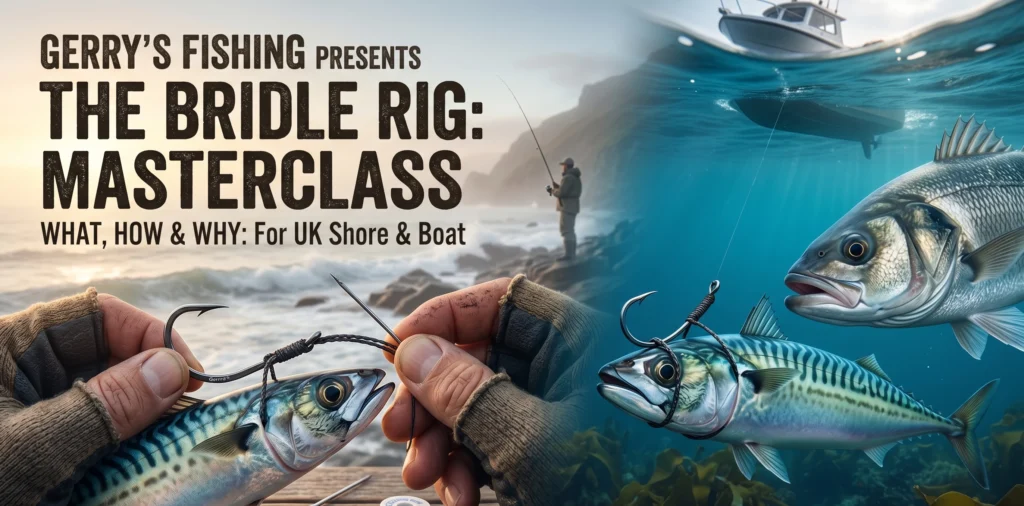
The Bridle Rig: What It Is, How to Tie It & Why You Need It | Written by Gerry’s Fishing
Welcome to another comprehensive guide from the team here at Gerry’s Fishing. As seasoned anglers on the Morecambe coast and across the UK know, presentation is everything. While traditionally associated with offshore big-game fishing, the Bridle Rig is taking UK sea fishing by storm—especially when targeting specimen Bass, Tope, and Smoothhounds.
If you are looking to maximize your hook-up rates and keep your live or dead baits fishing effectively for longer, understanding the bridle rig is essential. Here is our in-depth guide on what it is, how to tie it, and the gear you need to land your next personal best.
What is a Bridle Rig?
A bridle rig is a method of attaching a bait (live or dead) to a hook using a short loop of rigging floss, heavy braid, or an elastic bait band—known as the “bridle.” Instead of piercing the bait directly with the hook, the bridle is passed through the bait (often through the eye sockets or snout) and then secured to the hook.
This technique leaves the entire hook exposed, sitting proudly on the outside of the bait.
Benefits for UK Boat Fishing
Natural Swimming Action: When drifting live baits (like mackerel, sandeel, or pout) for Bass or Tope over reefs and banks, the bridle allows the bait to swim freely and naturally without the weight and restriction of a hook buried in its back or lip.
Unmatched Longevity: Live baits stay alive significantly longer because their vital organs and mobility aren’t compromised by thick hook gauge punctures.
Clear Hook Gape: When a predator strikes, the hook gape is completely free to find a secure hold, drastically increasing hook-up ratios, especially when paired with circle hooks.
Benefits for UK Shore Fishing
Casting Integrity: When power-casting large, heavy baits like whole squid or mackerel flappers from the beach, the bridle acts as a shock absorber. It prevents the hook from tearing through soft bait flesh under the force of the cast.
Perfect Presentation in Strong Tides: The bait remains streamlined in heavy coastal currents, reducing unnatural spinning and tangling.
Improved Bite Conversion: Shore anglers targeting Smoothhounds or Rays often miss bites when the hook point turns back into a bulky bait. The bridle ensures the hook is always primed and fully exposed.
How to Tie and Bait a Bridle Rig
Bridling a bait is quick and simple once you master the mechanics. Here is how to rig your bait perfectly every time:
Prepare the Bridle: Take a 3-to-4-inch loop of heavy rigging floss, braided line, or a tough elastic bait band. Loop it onto the bend of your hook using a simple girth hitch (loop-to-loop).
Thread the Needle: Hook the opposite end of the loop onto a bait rigging needle (an open-eye or latch needle is easiest).
Pierce the Bait: Carefully push the needle through the bait. For live fish, push it straight through the tough, clear cartilage just forward and above the eye sockets. For whole squid, pass it through the solid tip of the mantle.
Pull the Loop Through: Pull the needle all the way through until the loop emerges on the other side of the bait. Remove the needle from the loop.
Secure the Hook: Pass the point of your hook through the exposed loop.
Twist and Lock: Twist the hook 4 to 6 times to tighten the bridle material, pulling the hook tight against the bait’s head.
The Final Pass: To lock everything in place, pass the hook point back under the tightly twisted loop (sliding it right between the loop and the bait). The hook should now sit securely, flat against the bait.
Gerry’s Pro Tip: When bridling live baits for Bass, always match your hook size to the size of your bait, not just the target species. A 3/0 to 6/0 circle hook is perfect for standard mackerel. Furthermore, always wet your hands before handling live baits to preserve their protective slime coat—this ensures they stay livelier for longer!
Featured Products: Bridle Rig Tackle at Gerry’s Fishing
To get you set up for success and maximize your chances on the water, we stock the very best tackle designed specifically for this method. Here are the top products you need to properly execute the bridle rig.
1. Cox & Rawle Bridle Rig with Circle Hook
Product Description:
The Cox & Rawle Bridle Rig is a premium, ready-tied solution for anglers looking to implement live or large dead bait tactics instantly. Built right here in the UK, this rig features the notoriously sharp Cox & Rawle SCR44 Mutsu Circle hook. The circle hook design perfectly complements the bridle method; as the fish turns away with the bait, the exposed hook rolls and self-sets directly into the corner of the mouth. This minimizes deep hooking and ensures safe catch-and-release, making it the ultimate rig for specimen Bass, Tope, and Smoothhound. Pre-assembled with a heavy-duty trace and high-quality swivels, it is built to withstand the brutal, sustained runs of UK sea predators.
Specifications:
Hook Type: Cox & Rawle SCR44 Mutsu Circle Hook (Chemically sharpened)
Available Hook Sizes: 3/0, 4/0, 5/0, 6/0
Trace Material: Premium heavy-duty clear monofilament (80lb – 100lb breaking strain depending on hook size)
Components: High-tensile crane swivel, pre-tied durable bridle loop
Target Species: Bass, Tope, Smoothhound, Conger Eel
Best Paired With: Whole squid, live mackerel, large sandeels
2. Leadertec Stainless Steel Bridle Rig Needle
Product Description:
If you prefer tying and customizing your own rigs, the Leadertec Bridle Rig Needle is an absolute tackle box essential. Engineered from marine-grade stainless steel, this needle is specifically designed to cleanly pierce through tough bait cartilage without causing unnecessary trauma to live baits. The open-eye design allows for rapid attachment and detachment of rigging floss or bait bands, ensuring your bait spends less time out of the water and more time in the strike zone. Its ergonomic length provides the perfect leverage for quickly bridling both small live baits and massive whole dead baits.
Specifications:
Material: 100% Marine-Grade Stainless Steel
Design: Open-eye latch style for rapid loop threading
Lengths Available: 4-inch (standard baits), 6-inch (large baits)
Corrosion Resistance: Extremely high; fully saltwater safe
Uses: Live bait bridling, dead bait preparation, threading heavy traces through baits
Examples of Where to Use the Bridle Rig
Drifting the Banks (Boat): When drifting over sandbanks or wrecks in the English Channel or the Irish Sea, a bridled live pout or mackerel is deadly for large Bass. The natural presentation is completely unmatched in moving water.
Uptide Boat Fishing: Anchored up and casting away from the boat for Tope? A bridled whole mackerel flapper will sit perfectly in the tide run, emitting a heavy scent trail while keeping the hook completely clear of the bait for an instant, unimpeded hook-up when the Tope runs.
Rough Ground Shore Fishing: Casting from rock marks into heavy kelp for big Huss or Conger. Bridling a large section of squid or a fish head ensures the hook isn’t masked by the bait, which is crucial when you only get a split second to strike and bully the fish out of the snag.
Estuary Fishing: Targeting late-season Bass with live sandeel from the shoreline. A micro-bridle setup ensures the delicate sandeel isn’t killed by the hook gauge, allowing it to dart and flutter naturally in the shallow, fast estuary currents.
Frequently Asked Questions (FAQs)
Does the bridle rig hurt live baits?
When done correctly, it is actually far less damaging than traditional lip or back hooking. Passing the needle through the hard, fleshy cartilage above the eye sockets avoids the brain and vital organs, meaning the bait stays alive, comfortable, and highly active for much longer.
Do I have to use circle hooks with a bridle rig?
While you can use standard J-hooks or Octopus hooks, Circle hooks are highly recommended for this rig. Because the hook is fully exposed on the outside of the bait, a circle hook will naturally roll into the scissors (corner) of the fish’s mouth as it takes the bait and swims away, providing a flawless, secure hook-up without deep hooking.
What material should I use for the bridle loop?
For most UK sea fishing, waxed rigging floss, heavy Dacron, or thick braided line works brilliantly. For smaller baits or a faster setup, small elastic bait bands (similar to those used in coarse fishing but scaled up) are extremely effective, easy to use, and grip the hook shank well.
Can I genuinely cast a bridle rig from the shore?
Absolutely. In fact, it’s a fantastic shore rig for big baits. The bridle loop absorbs the initial pressure of the cast, meaning soft baits like squid or bluey are far less likely to tear off the hook during a powerful pendulum or off-the-ground cast.
Is the bridle rig strictly for saltwater fishing?
Not at all. The bridle rig is incredibly effective for UK freshwater predator fishing, particularly when targeting large Pike with live or dead baits. The core principles of a clear hook gape and highly natural bait presentation apply just as effectively in rivers and lakes.