

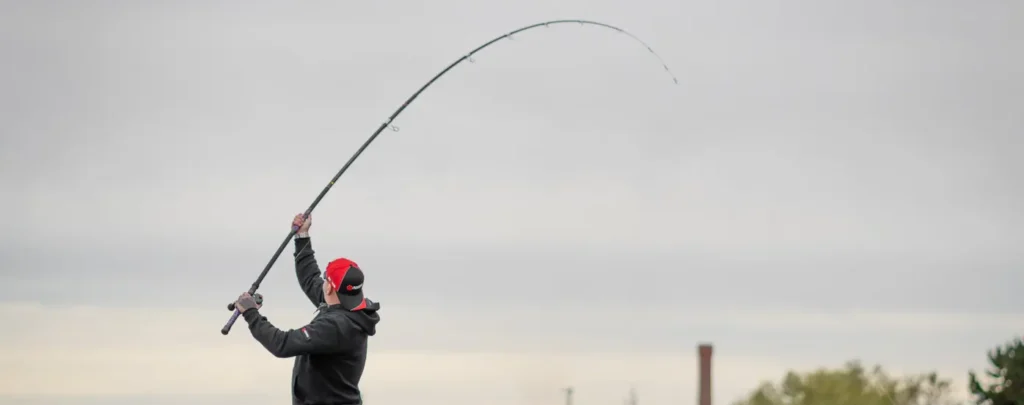
Welcome to the Gerry’s Fishing blog. If you spend enough time on the shingle or sand, you quickly realize that while fish can occasionally be caught at your feet, hitting those outer sandbanks and deeper gullies is often the difference between a blank session and a full cooler.
Casting distance isn’t just about brute strength; it’s about physics, timing, and rod compression. Whether you are throwing heavy crab baits for winter cod or launching delicate worm rigs for summer flats, maximizing your yardage opens up far more water.
Here is our in-depth masterclass on refining your basic technique and stepping up to advanced casts to unlock your rod’s true potential.
1. Perfecting the Overhead Cast (The Foundation)
The overhead cast (or basic thump) is where everyone starts. It’s reliable, safe on crowded beaches, and perfect for short-to-medium ranges. However, most anglers bleed potential distance here through poor stance and arm mechanics.
Simple Tweaks for Immediate Yardage
The “Push-Pull” Lever: Your rod is a lever. Don’t just push forward with your top hand (the one near the reel). You must simultaneously pull down hard with your bottom hand (on the butt). This explosive snap creates the compression needed to launch the lead.
The Stance: Step your non-dominant foot forward, pointing toward your target. Your back foot should be planted perpendicular to your target. Transfer your weight from your back foot to your front foot as you pivot through the cast.
The Drop: The “drop” is the length of line between your rod tip and your sinker. For an overhead cast, lengthen your drop so the lead hangs about halfway down the rod. A longer drop loads the rod deeper into the blank rather than just bending the tip.
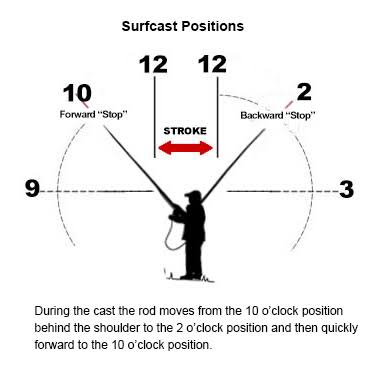
How to Execute the Overhead Cast
Set Up: Face your target. Extend your arms so the rod is held directly overhead, angled slightly backward (around the 2 o’clock position if looking from the side).
The Drop: Check that your lead is hanging roughly halfway down the rod blank. Ensure the line is trapped securely on your finger or trigger.
The Strike: Step forward with your leading foot. In one smooth, accelerating motion, push your top arm forward and pull your bottom arm straight down to your chest.
The Release: Release the line when the rod reaches roughly the 10 o’clock position (pointing upward at about a 45-degree angle).
Follow Through: Keep the rod pointing at the flying lead as it sails, minimizing friction through the guides.
2. Taking the Next Step: Ground vs. Pendulum Casting
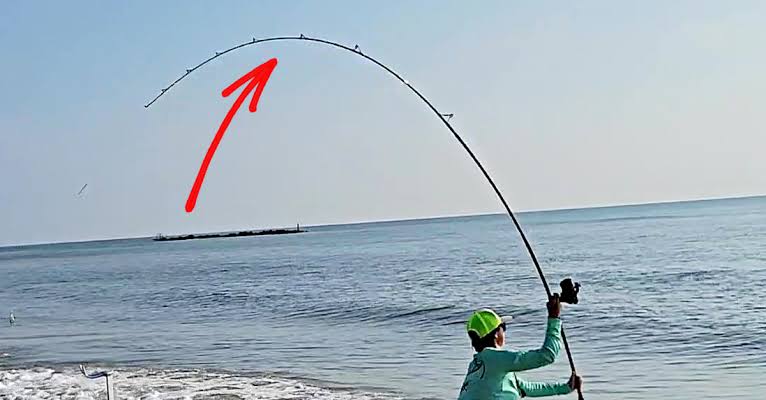
Once you max out the overhead cast, you need techniques that generate a wider arc. A wider arc means the lead travels further before release, building more speed and compressing the rod heavily.
| Feature | The Ground Cast | The Pendulum Cast |
| Best For | Heavy baits, reliable distance, night fishing | Maximum extreme distance, tournament casting |
| Difficulty | Moderate | High |
| Space Needed | Moderate (requires clear ground behind you) | Large (requires significant aerial clearance) |
| Pros | Highly accurate, easier to learn, minimal risk of tangles | Generates the highest possible rod compression and speed |
| Cons | Can snag on rough or rocky beaches | Requires perfect timing; dangerous if executed poorly |
Pro Tip: Do not attempt a pendulum cast until your ground cast is flawless. A poorly timed pendulum will actually cast shorter than a good overhead thump, and you risk snapping your rod or endangering others.
3. How to Execute the Ground Cast
The ground cast (or off-the-ground cast) builds immense power by placing the sinker on the beach behind you, expanding the casting arc to 270 degrees.
Examples of where to use: Open sandy beaches, clean shingle, and situations where you are throwing heavy, aerodynamic rigs for maximum hunting range.
The Stance: Stand sideways to the sea. If you cast right-handed, your left shoulder points at the target.
The Setup: Swing the lead behind you and lay it on the sand. The lead should be positioned outside your right foot, pointing away from the sea. Your drop should be long—almost down to the reel.
The Body Coil: Twist your torso away from the sea, looking back at your sinker. Keep your arms extended.
The Pivot and Pull: Begin the cast by turning your hips and head aggressively toward the sea. Drag the sinker across the sand for a fraction of a second before the rod lifts it.
The Punch: As your body faces forward, execute the push-pull motion with your arms. The rod will travel in a massive arc over your shoulder, compressing heavily before you release at 45 degrees.
4. How to Execute the Pendulum Cast
The pendulum cast is the undisputed king of distance. Instead of laying the lead on the ground, you swing it outward and upward, using the momentum of the swinging lead to pre-load the rod before you even begin the forward punch.
Examples of where to use: Tournament fields, completely empty beaches, and situations requiring 150+ yard casts to reach the fish.
The Stance: Stand facing away from the sea, or slightly angled.
The Out-Swing: With a long drop (lead near the reel), gently swing the lead out in front of you (away from the sea) until it is about eye level.
The In-Swing: Let gravity pull the lead back toward you, passing your body on the outside (right side for right-handers).
The Turn: As the lead swings back and starts to rise behind you, pivot your hips and torso aggressively toward the sea.
The Power Stroke: The lead is now high in the air behind you. As it hits its apex, pull the rod around and over in a massive, sweeping arc. The rod will bend into a “U” shape under the G-force of the flying lead. Execute the push-pull and release.
Gerry’s Fishing FAQs
Do I need a shock leader to cast further?
Yes, absolutely. A shock leader (typically 10lbs of breaking strain for every ounce of lead) is vital for safety, but it also allows you to hit the cast with 100% of your power without fear of snapping the line. You cannot achieve true distance if you are subconsciously holding back.
Does a longer rod mean longer casts?
To an extent. A 13ft to 15ft rod provides a longer lever and keeps the line higher above the surf. However, if a rod is too stiff or too long for your physical strength, you won’t be able to compress it. A fully compressed 12ft rod will always out-cast an uncompressed 15ft rod.
Why does my bait keep exploding mid-air?
High-speed casts subject baits to immense G-force. Always use bait elastic to bind your lugworm, crab, or squid tightly to the hook. A streamlined, aerodynamic bait drastically improves your overall yardage.