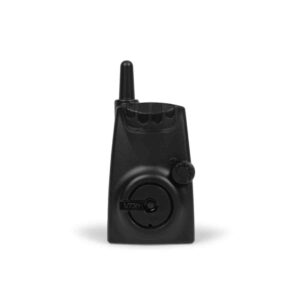
Bite Alarm Receivers: The Remote Command Center for Your Peg
In the world of specimen angling, the Bite Alarm Receiver is the bridge between your rods and your bivvy. Gone are the days of straining to hear a faint bleep over the wind or missing a “one-toner” while brewing a coffee in the back of your shelter. A high-quality receiver acts as a remote pager, mirroring every tone, light, and vibration from your alarms directly to your hand or bedside. At Gerry’s Fishing, we stock a wide array of receivers—from standalone units to part of full presentation sets—designed to keep you connected to your terminal tackle with 100% reliability.
A modern receiver is more than just a speaker; it is a sophisticated piece of digital hardware featuring encrypted frequencies, multi-channel synchronization, and extended signal range. Whether you are fishing in dense woodland or on a massive inland sea, a dedicated receiver ensures you are always the first to know when a fish makes its move.
Technical Specifications & Digital Performance
Selecting a receiver requires matching the technology to your specific alarm heads. Below is a breakdown of the core specifications found in modern remote systems.
| Feature |
Standard Wireless Receiver |
Pro Digital Receiver |
Universal/Bluetooth Receiver |
| Transmission Range |
100m – 200m |
500m – 1km+ (Digital) |
50m – 150m |
| Channel Capacity |
3 to 4 Channels |
6 to 8 Channels |
App-Integrated / Unlimited |
| Alert Modes |
Audio & Visual |
Audio, Visual & Vibration |
Audio, Visual & Smartphone Alert |
| Frequency Tech |
433MHz FM |
I-Com / Advanced Digital |
Bluetooth Low Energy (BLE) |
| Battery Life |
100 – 200 Hours |
500+ Hours (Ultra-Low Drain) |
Rechargeable Li-Ion |
| Housing |
Weatherproof ABS |
Fully Gasket-Sealed / IPX6 |
Splash-Proof |
Pro Tip: The “Stealth & Speed” Configuration
To maximize your edge on busy club waters or when “stalking” shy fish, turn the volume on your bite alarm heads to zero and rely entirely on the vibration mode of your receiver. By keeping the receiver in your pocket or around your neck on a lanyard, you receive instant, silent notification of a take. This prevents “scaring” fish in the margins with loud bleeps and stops other anglers from noticing you’ve had a run, allowing you to work your peg in total stealth.
Applications: Where to Use a Dedicated Receiver
-
Dense Bivvy Sessions: When you are tucked away in a twin-skin bivvy during a storm, the sound of an alarm head can be muffled by wind and rain hitting the canvas. A receiver placed next to your bedchair ensures you never miss a beat, even in the worst weather conditions.
-
Long-Range & “Around the Corner” Swims: If your rods are positioned on a point or around a reed bed where you don’t have a direct line of sight, a high-output digital receiver (like those found in the Fox RX+ or Delkim Rx-D series) can penetrate thick foliage and navigate around obstacles to keep you connected.
-
Social Fishing & Cooking: If you have wandered to the next swim for a chat or are busy at the back of your peg preparing a meal, a receiver with a 200m+ range allows you to stay mobile without being “tethered” to your rods.
Frequently Asked Questions (FAQs)
Q: Can I use any receiver with any brand of bite alarm?
A: Generally, no. Most manufacturers use proprietary, encrypted radio frequencies to prevent “crosstalk” (where you hear another angler’s bleeps). For example, a Fox receiver will only work with Fox wireless alarms. If you have non-wireless alarms, you may be able to use a “universal” receiver system that plugs into the extension sockets of your alarm heads.
Q: How do I “pair” a new alarm to my receiver?
A: Most modern receivers feature a “Program” or “Sync” button. Usually, you put the receiver into pairing mode and then trigger the alarm head (by spinning the roller wheel). The receiver will then “lock” onto that alarm’s unique digital ID. Always check your specific manual, as some systems require a specific sequence of button presses.
Q: What happens if someone else on the lake has the same alarms?
A: Professional-grade receivers use “Digital Rolling Codes” or unique ID signatures. This ensures that even if 50 people on the same lake are using the same brand of alarm, your receiver will only respond to your specific heads.
Q: Why is my receiver range shorter than the manufacturer claims?
A: Range ratings are typically “line-of-sight” in open fields. In the real world, factors like high-voltage power lines, thick wet foliage, atmospheric pressure, and even the height of your banksticks can reduce range. To improve signal, ensure your receiver is kept off the ground and away from large metal objects.
Q: Are receivers waterproof?
A: Most premium receivers are highly weather-resistant (IPX-rated), meaning they can handle rain and dampness. However, they are not designed to be submerged. We always recommend keeping your receiver in a clear protective silicone skin or a dedicated pouch to prevent internal condensation.