

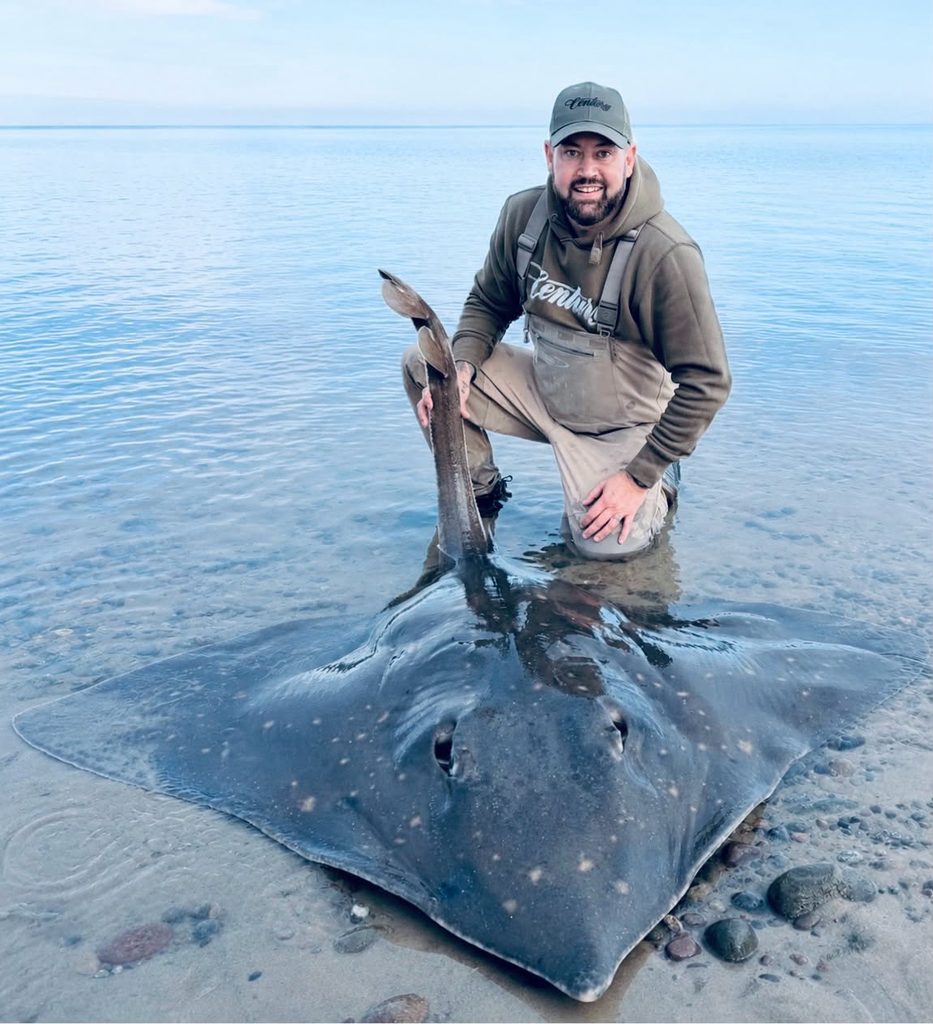
An Absolute Behemoth From the Depths: Danny’s Unforgettable Common Skate
There are fishing sessions, and then there are sessions that stay with you forever — the ones you replay in your head on the drive home, the ones you tell your mates about for months afterward, the ones that remind you exactly why you fell in love with this sport in the first place. For Danny, one of our team here at Gerry’s Anglers, this was one of those sessions. What started as another session chasing one of Scotland’s most iconic and elusive fish turned into an encounter with an absolute behemoth from the depths — a stunning female common skate that tested every ounce of skill, patience, and tackle Danny had brought with him.
This is the full story of that fight: the setup, the take, the battle, the landing, and the careful release that sent a magnificent fish back to where she belongs. Along the way, we’ll break down the gear that made it possible, the technique behind the rig, and why moments like this matter so much to anglers who respect the fish as much as they respect the fight.
Setting the Scene
Common skate don’t give themselves up easily. Once found right around the British Isles, this extraordinary species — now more accurately known to science as the flapper skate, and classed as one of the largest and most critically endangered fish in our waters — has retreated to a handful of strongholds where deep water, strong tides, and a healthy food chain still allow it to thrive. Scotland’s sea lochs and west coast marks are among the last truly reliable places left on earth to target one of these giants, and anglers who fish for them do so with an enormous amount of respect for just how special, and how vulnerable, the species really is.
Danny had made the journey north with exactly that respect front of mind. As with most serious skate sessions, the precise mark he fished is being kept deliberately out of this story. That’s not for dramatic effect — it’s standard practice among the skate-fishing community. These marks hold populations of a genuinely endangered species, and protecting them from excess pressure, overcrowding, and disturbance is something every responsible angler takes seriously. The location stays private; the story, thankfully, doesn’t have to.
Skate fishing from the shore or from an anchored boat in Scottish waters is a different discipline entirely from most other forms of UK angling. It demands specialist tackle capable of handling a fish that can weigh well over a hundred pounds, a location with the right depth and tidal flow to hold fish consistently, and above all, patience. Bites can be few and far between, sessions can pass without so much as a knock, and when a big skate does finally pick up a bait, everything that follows happens on an entirely different scale to normal fishing.
On this particular session, everything came together. The tide was right, the mark was right, and — as it turned out — there was a genuinely exceptional fish patrolling the depths below.
The Rig: A Pulley Dongle Built for Power
Before we get into the fight itself, it’s worth taking a moment to appreciate the setup Danny was using, because the rig is really the unsung hero of any big-fish capture. Get it wrong, and even the best angler in the world can lose a fish of a lifetime to a hook pull, a frayed line, or a snapped trace. Get it right, and you give yourself the very best chance of turning a take into a photograph — and, just as importantly, of returning a vulnerable species to the water in the best possible condition.
Danny was fishing a pulley dongle rig — a rig that has become the standard setup among serious skate anglers fishing static baits over deep, often snaggy ground. The beauty of a pulley-style rig lies in how it behaves the instant a fish picks up the bait and moves off with it. Rather than pulling the hook directly against the resistance of a fixed lead, the pulley mechanism allows the hook to be drawn up and back at an angle as the fish moves off, which dramatically increases the chances of a solid, positive hook-set in the tough, cartilaginous mouth of a big skate.
The “dongle” element refers to the drop-off or semi-fixed lead arrangement, designed so that in the event of a lost or tangled rig, the lead itself can shed away rather than becoming a hazard left in the water attached to a hook. For anglers who take fish welfare seriously — and that’s every single one of us here at Gerry’s Anglers — this is a non-negotiable part of any big-fish setup, and it matters more than ever when the species on the other end is as precious as the common skate.
The Line: 200lb Mono
Tied into this rig was 200lb mono — a breaking strain that might sound extreme to anglers who haven’t fished for skate before, but which is entirely standard, and honestly essential, when there’s a genuine chance of hooking into a fish capable of using its huge, kite-shaped body as a sail against the tide. Big skate don’t just pull hard; they use their sheer surface area and body weight to generate a sustained, grinding resistance that can find any weakness in tackle within seconds. An abrasion nick against rough ground, a wind knot, a moment of complacency, and 200lb line can part just as easily as anything lighter.
Mono, rather than braid, is a deliberate choice for this kind of fishing too. Its inherent stretch acts as a shock absorber during the powerful, twisting lunges a big skate will throw when it senses danger — particularly in those final, heart-in-mouth moments as the fish comes up off the bottom and toward the surface. That forgiveness in the line can be the difference between a fish staying pinned and a hook pulling free at the worst possible moment.
The Hook: 6/0 Cox & Rawle Catfish Hook
Armed at the business end was a 6/0 Cox & Rawle catfish hook — a pattern trusted by big-fish anglers well beyond its namesake species, precisely because it’s built to take serious punishment. A big, old female skate has a tough, cartilaginous mouth structure, and driving a hook home into that requires both a hook with genuine strength in the wire and an angler willing to make sure the hook-set counts. Cox & Rawle hooks have built a reputation in the specialist angling world for exactly this kind of application — strong, sharp, reliable, and able to hold firm through everything a big fish can throw at them, regardless of what species it was originally designed with in mind.
Put all of that together — the pulley mechanism, the drop-off dongle safety feature, the 200lb mono, and the 6/0 Cox & Rawle hook — and you have a rig purpose-built for one outcome: giving the angler the very best chance of landing a serious fish safely, while never compromising on the welfare of an animal as precious as the common skate.
The Take
Anyone who has fished seriously for skate will tell you that the take is unlike almost anything else in UK angling. There’s often a long, patient wait beforehand — sometimes hours — followed by a moment of total, unmistakable authority. There’s no subtlety to it whatsoever. One moment the rod tip is still, the water is quiet, and the only sound is the tide working against the boat or the shoreline. The next, everything happens at once.
That’s exactly how it unfolded for Danny. The moment she picked up the bait, there was no mistaking it. The rod didn’t just twitch or nod — it was pulled round with an immediate, unmistakable authority that told Danny everything he needed to know before he’d even lifted into the fish. This wasn’t going to be an ordinary skate. The sheer, immense power transmitted up through the rod in that first instant was the kind of thing that gets the heart hammering and the adrenaline surging in a way that few other moments in fishing can match.
Danny struck into the fish, felt the solid, immovable weight on the other end, and immediately understood he was attached to something very special indeed.
The Fight: Steady, Demanding, and Incredibly Physical
What followed was, by Danny’s own account, one of the toughest and most rewarding fights of his angling life. This wasn’t a fish that came in easily, and it wasn’t a fight that was won in the first few frantic minutes. Instead, it settled into something steady, demanding, and incredibly physical — a genuine battle of strength, technique, and nerve that tested Danny and his tackle in equal measure.
Big female skate, particularly specimens of this calibre, don’t panic and thrash about wildly the way smaller fish often do. Instead, they rely on sheer bulk, body shape, and raw power. This fish did exactly that. She used her considerable weight and wide, kite-like wingspan to hold deep, effectively turning her whole body into dead weight against the tide, refusing to be bullied, letting her size do the work rather than expending energy on erratic runs. Every time Danny applied pressure, she simply absorbed it, using the water itself and the pull of the tide as an ally against him.
At intervals throughout the fight, she would surge away, powerful, deliberate runs that peeled line and reminded Danny in no uncertain terms just how much fish he was dealing with. These surges are where a lot of big skate are lost. The temptation in the heat of the moment is to try to stop a run dead, to clamp down and refuse to give an inch — but that’s often exactly the wrong move. Too much resistance against a determined run from a fish of this size can either see a hook pull free or the line find its breaking point. Danny had to read every surge as it happened, judging exactly how much pressure the rod, the line, and the hook-hold could take, and easing off at precisely the right moments to let the fish tire herself out on her own terms.
It’s worth pausing here to talk about what that actually feels like from the angler’s side of things, because it’s genuinely difficult to convey to anyone who hasn’t experienced it. Every lift of the rod was met with solid, immovable resistance — the kind of dead weight that makes your arms burn and your forearms ache within minutes. There’s no give, no easy inch gained. You lift, you feel the fish shift its weight in response, and you wind down to gain what little line you can before she surges again and takes it all back. It’s a rhythm of small victories and setbacks, repeated over and over, for as long as the fish decides it needs to last.
This is where tackle quality stops being a marketing buzzword and starts being the difference between success and heartbreak.
The Rod: A Century X90 Pushed to Its Limits
Throughout this entire physical, grinding battle, the rod Danny had in his hands was a Century X90 — and by his own account, it performed perfectly from start to finish.
There’s a common misconception in specimen angling that a rod built for genuinely big, powerful fish has to be a thick, heavy, unwieldy pole of a thing. The Century X90 proves that assumption wrong. Despite its notably slim profile and famously responsive action, the rod showed more than enough power throughout the entire fight to handle a fish of this size and strength. That’s no small thing when you’re up against a skate capable of holding deep and surging with the kind of raw force this one displayed.
What makes a rod like the X90 so effective in this situation comes down to how it distributes load. A slim, well-designed blank doesn’t just look elegant on the rod rest — it flexes progressively through its length, absorbing sudden shocks and powerful runs without transmitting all of that violence directly into the hook-hold or the angler’s hands. Every powerful run the fish threw during the fight was absorbed smoothly by the rod’s action, cushioning the strain on the line and hook while still allowing Danny to apply steady, meaningful pressure whenever the opportunity arose.
This combination — softness where it’s needed to protect the terminal tackle, and backbone where it’s needed to actually move a heavy fish — is exactly what separates a genuinely capable big-fish rod from one that simply looks the part. The Century X90 gave Danny the strength, the control, and crucially the confidence to keep working the fish steadily, phase by phase, through every lift, every give, and every hard-won foot of line regained, all the way from the depths where she’d been holding up through to the shallows near the shore.
Confidence matters enormously in a fight like this. When an angler trusts their rod completely, they can commit to the fight fully — applying pressure when it’s needed rather than hesitating out of fear the rod might not handle it. That trust translates directly into a more controlled, more effective fight, and ultimately into fish landed safely rather than fish lost to over-caution or, just as damagingly, to too much force applied at the wrong moment.
The Final Stages: Bringing Her Into the Shallows
As the fight wore on and the fish gradually tired, Danny began to sense the shift in momentum. The runs became shorter. The dogged, deep holding became less absolute. Slowly — and it really is a slow, incremental process with a fish of this size and shape — she began to come.
As she came closer to the shore, the anticipation only grew. This is often the most nerve-wracking phase of any big-fish fight, and for good reason. A skate nearing the shallows is not a beaten fish; she’s simply a fish running out of the deep water she’s used to using as her advantage. In those final stages, in skinny water, a sudden lunge or roll can undo everything achieved over the previous twenty, thirty, or more minutes of careful, disciplined fighting — and with a fish whose wide, flat body can generate a surprising amount of leverage even at slow speed, this final stretch demands total focus.
Great care was taken to keep her settled and under control as she moved into the shallow water. There’s a real skill to this final phase — keeping the rod at the right angle, maintaining just enough pressure to stay connected and in charge without provoking a last, panicked surge, and reading the fish’s body language as she adjusted to the changing depth around her. Danny managed this expertly, guiding her steadily rather than dragging her, allowing her to come in on her own terms while never relinquishing control.
Landing and Caring for a Magnificent Fish
Once she was safely landed, the priority shifted immediately from capture to care. This is a point that deserves real emphasis, because it’s exactly this kind of attitude — putting the fish’s welfare front and centre in the moments after landing — that defines responsible skate angling, and it’s something we’re incredibly proud to see reflected in how every member of the Gerry’s Anglers team approaches their sport. With a species as critically endangered as the common skate, careful, considerate handling isn’t just good practice — it’s essential to the future of the fishery itself.
She was given a quick check over the moment she was landed. This is standard best practice with any big skate and matters enormously: checking the hook-hold, checking for any signs of damage or distress, and making sure the fish is otherwise in good condition before anything else happens. With a fish of this size and importance, minimising time out of the water and stress on the fish is absolutely paramount.
Following that initial check, she was carefully supported in the water — her broad, flat body kept level, her weight properly distributed, and given the chance to recover her composure after the exertion of the fight. Big skate, much like other large elasmobranchs, can take a little time to settle after a prolonged battle, and rushing this stage does nothing but add unnecessary stress to an already demanding experience for the fish.
The Photographs
After she’d settled, a few photographs were taken to capture the moment — and it’s easy to understand why. A fish like this, a genuine behemoth pulled from the depths of a Scottish loch and one of the rarest, most remarkable species swimming in British waters, is the kind of capture that defines a season, maybe even a career. These are the images that will be shared, celebrated, and looked back on for years to come, and rightly so.
But it’s worth noting what a responsible photography process actually looks like with a fish of this size, because it’s about far more than just getting a good shot. Photographs with big skate are kept brief and purposeful. The fish is supported correctly throughout, weight distributed evenly across her wide, cartilaginous frame, no undue pressure placed on delicate areas, and the whole process happens as efficiently as possible so the fish spends the absolute minimum time away from being fully supported in the water. It’s a balancing act between wanting to properly document an incredible capture and never losing sight of the fact that the fish’s wellbeing comes first, last, and always.
The Release: Where She Belongs
With the photographs taken, the final and most important phase of the whole encounter began: the release.
She was walked back out and allowed time to recover properly. This isn’t a step to be rushed, and it wasn’t rushed here. Big fish that have fought hard need time — sometimes a considerable amount of it — to recover their strength and equilibrium before they’re ready to swim off under their own power. Holding her gently, facing into the current, giving her the chance to move water over her gills and rebuild her energy, is a critical part of ensuring she goes back exactly as strong as she was when she first engulfed that bait.
And recover she did. She soon began to kick strongly — a fantastic sign, and honestly one of the most satisfying moments in the entire process for any angler who’s just spent the better part of an hour locked in battle with a fish. That strong kick is the unmistakable signal that a fish is ready, that the fight and the handling haven’t taken more out of her than she can recover from, and that she’s about to go exactly where she belongs.
She swam away with plenty of power, no hesitation, no sign of distress — just a big, strong, healthy fish returning to the water with the same authority she’d shown the moment she first took the bait. Before long, she’d quickly returned to the depths, disappearing back into the dark Scottish water she’d come from.
Exactly where a magnificent fish like this belongs.
Why Moments Like This Matter
It would be easy to reduce a story like this down to the numbers — the size of the fish, the breaking strain of the line, the size of the hook — but doing so misses what actually makes this capture special. This wasn’t just about landing a big fish. It was about doing everything right, from the rig choice through to the final release, to make sure that a critically endangered, genuinely irreplaceable animal was treated with the respect and care it deserved throughout the entire process.
The common skate is one of the great conservation success stories of catch-and-release angling in the UK. Once heavily depleted, the species now survives in meaningful numbers largely thanks to a dedicated community of anglers who fish for them responsibly, release every single fish they catch, and go out of their way to protect the handful of marks where the species still thrives — which is exactly why the location of this catch is being kept private. Every angler who fishes seriously for skate understands that protecting these marks from excess pressure is part of the deal.
Danny’s session is a genuinely great example of what modern specimen angling should look like. It’s not about brute force or treating a fish as a trophy to be conquered and forgotten. It’s about matching the right tackle to the challenge, fighting the fish fairly and skilfully, minimising stress and handling time, and ultimately watching a magnificent, rare animal swim away stronger for having been briefly, carefully, respectfully in an angler’s hands.
That’s the standard we hold ourselves to here at Gerry’s Anglers, and it’s exactly the standard Danny set with this capture.
A Closer Look at the Gear That Made It Possible
For anyone reading this who’s inspired to have a go at targeting big skate themselves, it’s worth breaking down exactly why each element of Danny’s setup worked so well together, because none of these choices were made in isolation.
The pulley dongle rig gave the best possible chance of a solid hook-set the instant the fish moved off with the bait, while the drop-off lead arrangement kept fish welfare at the centre of the setup even in a worst-case scenario.
The 200lb mono provided the abrasion resistance and shock-absorbing stretch needed to survive the kind of sustained, grinding pressure a big skate can exert with its body and the tide working together, without sacrificing the forgiveness needed during those final, close-quarters moments.
The 6/0 Cox & Rawle hook offered the strength and sharpness required to get a positive hook-hold into a powerful mouth and keep it there through everything the fight demanded.
The Century X90 rod tied the whole setup together, delivering a rare combination of a slim, responsive, pleasurable-to-fish-with action alongside genuine, fight-ending power when it mattered most.
None of these components would have been enough on their own. It’s the combination — each part doing its job, each part trusted completely by the angler using them — that turns an encounter with a genuinely huge fish from a story of what got away into a story worth telling.
Final Thoughts
Sessions like this are exactly why so many of us keep making the journey to Scotland’s remote lochs and marks, session after session, in all weathers, at all hours, chasing that unmistakable, immense pull that tells you something special has picked up the bait. Danny’s fish was steady, demanding, and incredibly physical from start to finish — a proper battle that tested tackle, technique, and nerve in equal measure.
But more than anything, it was a fight fought and finished the right way: a truly stunning female common skate, landed safely, cared for properly, photographed respectfully, and returned to the depths every bit as strong as she’d been when she first engulfed that bait.
An absolute behemoth, and an absolute credit to the way Danny — and the whole team here at Gerry’s Anglers — approach this incredible sport.
Tight lines, and here’s to the next one.
Got a catch of your own you’re proud of? Tag Gerry’s Anglers on social media — we love seeing what our team and our community are landing out there. And to protect the fish and the fishery, we’ll always keep the exact marks for species like the common skate between us and those who fish them responsibly.