

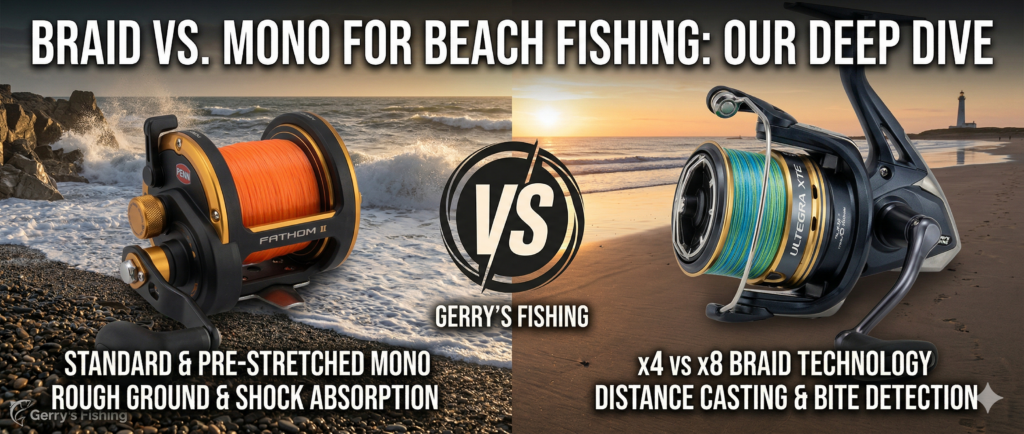
Braid vs. Mono for Beach Fishing: Our Deep Dive
Written by the Gerry’s Fishing Team
Walk onto any shingle beach, pier, or rock mark around the UK coast, and you are guaranteed to overhear one specific debate echoing above the sound of the crashing surf: Should I be spooling up with braid or monofilament? Here at Gerry’s Fishing, we have seen the evolution of sea angling tackle firsthand. We remember the days when thick, wiry nylon was the only option for hauling cod from rough ground. We also watched the “continental revolution” sweep the beaches, bringing with it ultra-thin braided lines and longcast fixed spool reels that entirely transformed distance casting.
However, the truth is that neither line type is universally “better” than the other. Both braid and monofilament are highly engineered tools, and like any tool, their effectiveness relies entirely on the job you are asking them to perform, the reel you are using, and the ground you are fishing over.
In this comprehensive guide, we are taking a deep dive into the science, manufacturing, and practical application of both braid and monofilament. We will explore how they are made, the distinct advantages of x4 versus x8 braids, the differences between standard and pre-stretched mono, and exactly which line you should be tying onto your shock leader for different beach fishing scenarios.
The Anatomy of Braided Lines: What They Are and How They Are Made
To understand why braid behaves the way it does on the beach, we have to look at it on a molecular level. Unlike monofilament, which is a single extruded strand of plastic, modern braided fishing lines are complex textiles. They are spun from Ultra-High-Molecular-Weight Polyethylene (UHMWPE), a synthetic polymer most commonly known by brand names like Spectra or Dyneema.
Pound for pound, UHMWPE fibers are up to 15 times stronger than steel. This incredible strength-to-diameter ratio is what gives braid its primary advantage in sea angling: you can achieve massive breaking strains with a fraction of the thickness of monofilament.
The Gel-Spinning Process
The creation of braided line begins with a process called gel-spinning. The raw polyethylene is dissolved in a chemical solvent to untangle its polymer chains. This gel is then forced through a spinneret (a device resembling a microscopic showerhead) and drawn out through a cooling bath. As the solvent evaporates, the polymer chains align perfectly parallel to one another. This parallel alignment is the secret to braid’s near-zero stretch and immense tensile strength.
The Braiding Process
Once the raw, hair-like fibers are created, they must be woven together into the final line. This is done using highly complex braiding machines. The raw fibers are bundled into “carriers” (or strands). The machine weaves these carriers around each other in a specific pattern, intersecting at precise angles. The number of carriers used—typically 4 or 8 in sea fishing applications—drastically alters the final physical profile of the line.
Finally, the woven braid is often treated with proprietary resins or coatings. These coatings serve several vital purposes for the beach angler: they reduce water absorption, enhance the line’s colorfastness against saltwater UV degradation, and provide a smoother outer shell to increase abrasion resistance and reduce friction through the rod guides.
Gerry’s Pro Tip: Because braid has virtually zero stretch (usually less than 3%), it offers unparalleled bite detection. A delicate tap from a flatfish at 150 yards will transmit straight down the line to your rod tip without being absorbed by elasticity.
Product Spotlight: Tronixpro Blaze X4 Braid
Product Description:
The Tronixpro Blaze X4 is a rugged, highly visible, four-carrier braided mainline designed specifically for the demanding conditions of UK shore fishing. Engineered to withstand the rigors of weed, tidal pull, and everyday beach casting, it offers a fantastic entry point into braided setups without compromising on reliability. The high-visibility color ensures you can track your line angle easily in the surf, making it easier to untangle crossed lines on busy beaches.
Specifications:
-
Type: 4-Carrier Braided Mainline
-
Material: 100% UHMWPE Fibers
-
Spool Size: 300m / 600m options
-
Available Strains: 20lb, 30lb, 40lb
-
Key Features: High abrasion resistance, excellent knot strength, vivid color retention, budget-friendly performance.
The X-Factor: Casting x8 vs. x4 Braids
When browsing our line section at Gerry’s Fishing, you will inevitably see braids advertised as “x4” (4-strand) or “x8” (8-strand). This refers directly to the number of carriers woven together to create the mainline. Understanding the difference between the two is critical for maximizing your casting distance and adapting to your fishing environment.
The Rugged Workhorse: x4 Braid
An x4 braid utilizes four thick bundles of UHMWPE fibers. Because there are fewer strands, each individual strand is inherently thicker and more robust.
The Profile: If you look at an x4 braid under a microscope, it is not perfectly round; it has a slightly square, textured, or “bumpy” profile. When you run your fingers along an x4 braid, it feels noticeably rougher than an x8.
The Sound: When casting or retrieving, x4 braid produces a distinct “zipping” or “sawing” noise as the textured profile rubs against your rod’s ceramic guides.
The Advantage: The main advantage of x4 braid is its durability. Because the individual strands are thicker, they are much harder to cut. If you are fishing near abrasive features like shingle banks or light mixed ground, an x4 braid will withstand scuffing much better than an x8. Furthermore, that rough texture acts like a micro-saw, allowing it to cut through light kelp fronds or thick weed more effectively than a smoother line.
The Distance Champion: x8 Braid
An x8 braid takes eight thinner bundles of fibers and weaves them together into a much tighter, more intricate pattern.
The Profile: The resulting line is incredibly smooth, supple, and perfectly round.
The Sound: Because of its smooth, cylindrical profile, x8 braid glides silently through the rod guides.
The Advantage: For pure beach casting—especially when chasing maximum distance on clean sand—x8 is the undisputed champion. The round profile drastically reduces the friction coefficient as the line uncoils from the reel and shoots through the guides. In the air, a perfectly round x8 line is highly aerodynamic, reducing drag and allowing your lead to fly further. In the water, x8 slices through lateral tides with minimal resistance, allowing you to hold bottom with lighter leads.
The only trade-off with x8 braid is that the ultra-thin individual strands are more susceptible to abrasion. If an x8 braid rubs hard against a sharp barnacle or a jagged rock, it can part much faster than an x4.
Product Spotlight: Daiwa J-Braid Grand X8
Product Description:
Daiwa’s J-Braid Grand X8 is the pinnacle of modern 8-carrier technology, formulated with Izanas (a premium Japanese PE material). It is arguably one of the most advanced casting braids on the market. It is tightly woven to create an exceptionally round profile that refuses to flatten out under tension. For the shore angler looking to hit the horizon with a continental setup, this line offers a near-silent cast and bites that register with electric urgency.
Specifications:
-
Type: 8-Carrier Braided Mainline
-
Material: Izanas Polyethylene (PE)
-
Spool Size: 150m / 300m / 3000m Bulk
-
Available Strains: 10lb to 80lb
-
Key Features: Perfectly round profile, ultra-smooth surface for reduced guide friction, low water absorption, exceptional tensile strength.
The Traditional Workhorse: Monofilament (Standard and Pre-Stretched)
Long before braided lines dominated the clean beaches, monofilament (nylon) was the king of the coast. And make no mistake—monofilament is far from obsolete. For many seasoned sea anglers, particularly those fishing heavy ground or using casting multipliers, mono remains the absolute best tool for the job.
Monofilament is exactly what its name implies: a single (mono) filament of plastic. It is manufactured by melting down nylon polymers (polyamides) and extruding the liquid plastic through a heated die, much like squeezing toothpaste from a tube. The hot plastic is immediately quenched in a cooling bath, which solidifies it into a continuous line.
Unlike braid, which is woven for strength and has zero give, monofilament’s molecular structure allows it to stretch. This elasticity is mono’s defining characteristic, acting as a vital shock absorber during aggressive casts and aggressive fights with heavy fish.
Standard Monofilament
Standard mono is the everyday workhorse. After extrusion, it retains a high degree of elasticity—sometimes stretching up to 25% or 30% of its length before breaking.
-
Shock Absorption: This massive stretch acts as a buffer. If a heavy cod makes a sudden, violent lunge in the crashing surf, standard mono stretches to absorb the shock, preventing the hook from tearing out or the line from snapping.
-
Abrasion Resistance: Because it is a single, solid, and relatively thick strand of plastic, mono is highly abrasion-resistant. When dragged across rocks, barnacles, or sharp shingle, it will scuff and scratch, but it rarely snaps instantly like braid does under tension.
-
Knot Strength: Standard mono is incredibly forgiving when it comes to knot tying. It “bites” into itself well, making standard blood knots, Grinners, and shock leader knots incredibly secure.
Pre-Stretched Monofilament
If standard mono has too much stretch for long-range bite detection, pre-stretched mono bridges the gap between traditional nylon and modern braids.
During the manufacturing process, after the line is extruded and cooled, it is reheated and subjected to massive mechanical tension, literally stretching the line out before it is spooled. This process permanently alters the line in two critical ways:
-
Reduced Diameter: By stretching the line out, the diameter physically shrinks. You can achieve a 15lb breaking strain in a diameter that would normally only yield 12lb in standard mono.
-
Reduced Stretch: The pre-stretching process aligns the polymer molecules more rigidly. This drops the line’s elasticity down from 25% to around 10-15%.
Pre-stretched mono gives the angler the best of both worlds: it retains enough abrasion resistance to handle light rough ground, but its lower diameter increases casting distance and its reduced stretch vastly improves bite detection at range. However, because it has already been stretched near its elastic limit, knot tying requires much more care, and the line is less forgiving of sudden, sharp shocks.
Product Spotlight: Asso Ultra Cast Mono
Product Description:
Asso Ultra Cast is a premium standard monofilament designed for the rigors of traditional UK shore fishing. Thanks to a specialized fluorocarbon coating over a highly durable nylon core, this line offers phenomenal abrasion resistance while maintaining enough suppleness to bed down perfectly on a multiplier reel. The controlled stretch provides excellent shock absorption when battling heavy fish in heavy surf.
Specifications:
-
Type: Standard Copolymer Monofilament
-
Material: Nylon core with Fluorocarbon coating
-
Spool Size: 4oz Bulk Spools (approx. 1000m+)
-
Available Strains: 15lb, 18lb, 20lb, 25lb, 30lb
-
Key Features: High knot strength, excellent abrasion resistance, supple memory-free formulation, robust shock absorption.
Product Spotlight: Trabucco Tournament Tough Mono
Product Description:
The Trabucco Tournament Tough is an ultra-thin, pre-stretched monofilament designed specifically for the match angler or distance caster who demands ultimate performance. By utilizing a high-tech pre-stretching process, Trabucco has created a line with a phenomenally low diameter-to-breaking-strain ratio. It slices through crosswinds and lateral tides with ease, allowing you to hit distances previously reserved for braid while retaining the user-friendly nature of nylon.
Specifications:
-
Type: Pre-Stretched Monofilament
-
Material: Advanced Polyamide Blend
-
Spool Size: 500m
-
Available Strains: 10lb, 12lb, 15lb
-
Key Features: Ultra-low diameter, minimal stretch for enhanced bite detection, incredibly smooth surface finish for reduced guide friction.
Braid vs. Mono: Beach Fishing Scenarios
Now that we understand the physical properties of these lines, let’s look at how they perform on the beach. Here is our breakdown of common UK fishing scenarios and which mainline you should choose.
Scenario 1: Clean Beach, Long Range Casting
Target Species: Whiting, Dabs, Plaice, Flounder, Sole.
The Winner: Braid (specifically x8)
When fishing over vast expanses of clean sand where distance is paramount, braid is untouchable. To reach fish feeding 150+ yards out, you need absolute minimal air resistance. A thin 15lb or 20lb x8 braid will cut through the air with zero drag compared to an equivalent strength mono.
Furthermore, once the lead hits the water, the lack of stretch in the braid means every tiny pluck from a 6oz Dab at maximum range is telegraphed instantly to the rod tip. Because the diameter is so thin, the line cuts through lateral tidal flow rather than catching it, allowing you to use lighter leads (like a 4oz or 5oz) to hold bottom, further refining your presentation.
Scenario 2: Heavy Rough Ground, Rocks, and Kelp
Target Species: Cod, Conger Eel, Bull Huss, Wrasse.
The Winner: Monofilament (Standard)
If you are fishing a notoriously snaggy mark full of jagged rocks, heavy kelp beds, and barnacle-encrusted ledges, braid is a liability. Braid is incredibly strong under direct, straight-line tension, but the moment a tight, stretched braided line touches a sharp edge, it shears instantly.
Monofilament is the undisputed champion of the rough ground. A heavy 25lb or 30lb standard mono mainline provides incredible abrasion resistance. It can be dragged over rocks and dragged through weed without parting. More importantly, when your lead is wedged in the rocks and a large Cod takes the bait, the stretch in the mono prevents the hook from tearing out during the fish’s sudden head-shakes.
Scenario 3: Heavy Surf and Thick Weed
Target Species: Bass, Winter Cod.
The Winner: Monofilament
After a heavy winter blow, the surf zone is often choked with loose weed, kelp, and debris. While you might think the thin diameter of braid would help cut through this, the reality is the opposite. The slightly textured surface of braid acts like Velcro for fine weed. The weed clings to the line, slides down under the pressure of the tide, and eventually forms a massive, heavy ball at your shock leader knot, threatening to snap your rod tip upon retrieval.
Monofilament, being a single smooth extrusion, sheds weed much better. While weed will still catch on a mono line, the smooth surface allows a lot of the finer debris to slide off or be easily picked off the line. Furthermore, the elasticity of mono forgives the sudden, violent surges of a weed-burdened rig tumbling in the shore break.
Scenario 4: High Winds and Strong Lateral Tide
Target Species: Rays, Smoothhounds, Bass.
The Winner: Braid
When you are fishing a deep water mark with a raging lateral tide and a howling crosswind, standard mono becomes a nightmare. The thick diameter of the mono catches the wind in the air (creating a massive bow in the line before the lead even hits the water) and catches the tide underwater. This excessive drag will constantly rip your lead out of the seabed, causing your rig to trot dangerously down tide and into other anglers’ lines.
Braid’s micro-diameter slices straight through the crosswind, eliminating the airborne bow. In the water, it acts like a wire, cutting cleanly through the tidal flow and allowing your breakaway lead to dig in securely.
| Scenario | Primary Challenge | Recommended Mainline | Why? |
| Clean Beach Distance | Reaching feeding fish, bite detection. | x8 Braid | Ultimate aerodynamics, zero stretch for instant bite indication. |
| Rough Ground/Rocks | Sharp snags, heavy abrasion. | Standard Mono | High abrasion resistance, stretch prevents shock-breakages. |
| Heavy Weed/Kelp | Weed clinging to line, heavy drag. | Standard Mono | Smooth surface sheds weed; stretch forgives weed-drag in the surf. |
| Strong Tides/Wind | Lead dragging, massive line bow. | x4 or x8 Braid | Low diameter cuts through wind and water, holding the lead firm. |
Reel Dynamics: Braid vs. Mono on a Longcast Fixed Spool
The reel you choose is just as important as the ground you are fishing when deciding between braid and mono. In the modern era, the longcast fixed spool (often called a “Big Pit” reel) paired with a long, soft-tipped continental rod has become the dominant setup for clean beach fishing.
Why Braid Excels on Fixed Spools:
Fixed spool reels and braided lines are a match made in heaven. When you cast a fixed spool, the line uncoils from the stationary spool in large, spiraling loops. These loops must quickly compress and pass through the butt guide (the first ring) of the rod. Because braid is incredibly limp and has zero “memory” (it doesn’t retain the coiled shape of the spool), it flows off the reel lip with minimal friction and straightens out effortlessly.
Modern fixed spools use advanced line-lay systems (like slow or super-slow oscillation) that pack the braid onto the spool in tight, parallel cross-wraps. This prevents the thin braid from biting or digging into itself under pressure.
Why Mono Struggles on Big Fixed Spools:
While you can use mono on a fixed spool, heavy mono (15lb+) has a high degree of memory. It wants to stay in the coiled shape it was stored in. When you open the bail arm, heavy mono tends to “spring” off the spool prematurely, leading to messy casts, “wind knots,” and severe friction as the stiff coils slap against the rod blank. If you must use mono on a fixed spool, a supple, low-diameter pre-stretched mono is highly recommended to reduce this coiling effect.
Product Spotlight: Shimano Ultegra XTE 14000
Product Description:
The Shimano Ultegra XTE 14000 is the benchmark for modern surfcasting fixed spool reels. Packed with advanced Shimano technologies like Super Slow 5 Oscillation and Infinity Drive, it is engineered to handle ultra-thin braids with absolute precision. The slow oscillation packs the braid perfectly parallel onto the spool, meaning that during a power cast, the line leaves the spool with almost zero resistance. The AR-C spool lip design further reduces friction, adding precious yards to every cast.
Specifications:
-
Type: Longcast Fixed Spool / Big Pit
-
Gear Ratio: 4.3:1
-
Weight: 600g
-
Max Drag: 20kg
-
Line Capacity: 0.35mm / 550m (Massive capacity for braided lines)
-
Key Features: Super Slow 5 Oscillation, CI4+ Body, Rigid Cast, AR-C Spool, X-Ship gearing.
Reel Dynamics: Braid vs. Mono on a Casting Multiplier
For the traditional UK angler utilizing a pendulum or off-the-ground power cast, the casting multiplier reel remains the ultimate weapon. Multipliers sit on top of the rod, and the spool physically revolves during the cast.
Why Mono is the Undisputed King of Multipliers:
Casting multipliers and monofilament have enjoyed a symbiotic relationship for decades. When you execute a 200-yard power cast, the spool of a multiplier can reach speeds exceeding 30,000 RPM. Monofilament, due to its slightly thicker diameter and suppleness, “beds” down beautifully onto a multiplier spool.
More importantly, the elasticity of mono acts as a crucial safety net. If you misjudge your cast, catch a crosswind, or your thumb slips, the multiplier spool will rotate faster than the line is traveling, resulting in an overrun (the dreaded “bird’s nest”). When an overrun occurs with mono, the sudden stop is cushioned by the line’s stretch. You might lose your rig, but your rod will survive.
The Dangers of Braid on a Multiplier:
Using braid on a casting multiplier for heavy beach work is generally discouraged and can be highly dangerous. Because braid is so incredibly thin and has zero stretch, it suffers from severe “bedding in.” When you reel in a heavy fish or drag a lead through the tide, the immense pressure forces the thin top layers of braid to slice deeply down into the loosely packed layers beneath it on the spool.
When you go to make your next cast, that trapped braid will catch abruptly. Because braid has absolutely zero stretch to absorb the shock, the spool stops dead instantly while the 6oz lead is traveling at over 100mph. This sudden, violent deceleration causes “crack-offs” (the shock leader knot snapping like a gunshot) and can even physically shatter the gears of the multiplier or snap the tip of the rod.
If you are using a multiplier from a boat, dropping straight down with braid is fantastic. But for power casting off the beach, monofilament is the only safe and reliable choice.
Product Spotlight: Penn Fathom II 15SD Mag Multiplier
Product Description:
The Penn Fathom II 15SD Mag is legendary among UK beach anglers. It is a rugged, beautifully engineered casting multiplier built specifically to handle the demands of heavy monofilament and pendulum casting. The externally adjustable magnetic braking system allows you to dial in the exact amount of spool control needed for changing wind conditions, preventing overruns before they happen. Its heavy-duty brass main gear and live spindle design ensure it can winch large cod out of rough ground day in, day out.
Specifications:
-
Type: Casting Multiplier (Star Drag)
-
Braking System: Adjustable Magnetic
-
Gear Ratio: 6.1:1
-
Weight: 480g
-
Line Capacity: 280yds / 15lb Mono
-
Key Features: Full Metal Body and side plates, Fast Gear Access Side Plate, 6+1 shielded stainless steel bearings, Versa-Drag system.
Frequently Asked Questions (FAQs)
Q: Do I still need to use a shock leader if my braid is strong enough?
A: Absolutely, yes. The golden rule of beach casting is 10lb of breaking strain for every 1oz of lead you are casting. A 5oz lead requires a minimum 50lb shock leader. Even if your braided mainline is 60lb test, braid has terrible knot strength under sudden shock and zero elasticity to absorb the massive G-forces generated during the casting stroke. Without a dedicated, heavy monofilament or heavy braided shock leader, you risk lethal crack-offs. Always use a leader to protect yourself and the anglers around you.
Q: What is the best knot for joining braided mainline to a mono shock leader?
A: Because braid is so thin and slick, standard mono knots will slip right through. The most reliable and secure knot for connecting thin braid to thick mono is the FG Knot. It works by utilizing the braid to tightly grip the outside of the monofilament without kinking it. It is also the slimmest knot available, meaning it passes through your rod guides silently and smoothly. If the FG knot is too difficult to tie on the beach, the Alberto Knot or the Mahin Knot are excellent, robust alternatives.
Q: Why do I keep getting “wind knots” when using braid on my fixed spool?
A: Wind knots (those frustrating, tangled loops that shoot through your guides during a cast) are rarely caused by the wind itself. They are usually the result of “loose line lay.” If you reel in your braid under zero tension (for example, if you are retrieving a bare rig with no lead, or walking forward while reeling), the braid wraps loosely onto the spool. On the next power cast, multiple loose coils are dragged off the spool simultaneously, tangling as they hit the first guide. To prevent this, always ensure you retrieve your braid under tension, pinching it lightly between your fingers above the spool if necessary.
Q: Does the color of my mainline matter?
A: For the fish, no. Your mainline should be suspended well above the seabed and far away from your baited rig. For the angler, color matters immensely. High-visibility colors like neon yellow, bright orange, or multi-color depth-marking braids are highly recommended. A bright line allows you to see exactly where your rig has settled in the surf, helps you track lateral drift, and is vital for untangling crossed lines when fishing closely with a buddy or in a crowded match scenario.
Q: How often should I replace my beach fishing mainline?
A: This depends on how often you fish and the terrain. Monofilament degrades over time due to UV exposure and saltwater saturation. A good rule of thumb for regular anglers is to change standard mono once a season. Braid, on the other hand, does not suffer from UV degradation or rot. A high-quality x8 braid can easily last three to four seasons if cared for. You only need to replace braid when you notice the line becoming “furry” (frayed from abrasion) or if you have lost too much line to snags and the spool is noticeably low, which will severely hamper your casting distance.
At Gerry’s Fishing, our team is always on hand to talk tackle. If you are still unsure whether your specific setup needs a tough monofilament or a silky-smooth x8 braid, pop into the shop in Morecambe or give us a call. We’ll make sure you hit the beach fully prepared for whatever the tide brings in.