

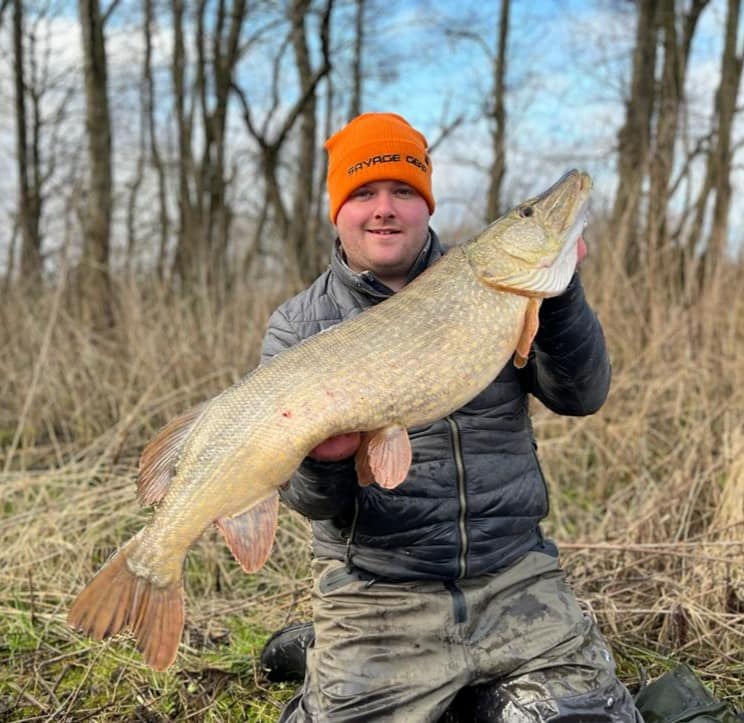
The Predator’s Pantries: A Guide to Deadbaiting for Pike
As the water clarity improves and the weed dies back in winter, the Pike (Esox lucius) becomes the primary target for many UK specimen hunters. Unlike the summer months where lures dominate, winter is the time for static deadbaits. The metabolism of the pike slows down, and they become scavengers, looking for an easy, high-calorie meal without expending energy.
To catch them, you need rigs that offer zero resistance, hold the bait securely during a cast, and present the offering naturally. Here is your guide to mastering the deadbait rig.
🛠 The Gear Room: Essential Rig Components
Pike have roughly 700 razor-sharp teeth and a bony, hard mouth. Your tackle must be robust enough to set a hook firmly and withstand abrasion, yet subtle enough not to spook a wary fish.
1. The Wire: Drennan E-Sox Piker Braided Wire
You cannot fish for pike without a wire trace. It is non-negotiable. Monofilament and fluorocarbon will be sliced instantly.
Product Description: Drennan E-Sox Piker Braided Wire is a woven stainless steel wire consisting of ultra-fine filaments. Unlike traditional single-strand wire which can kink and snap, this 7-strand braid is supple, knots easily, and resists kinking. It has a “low-glare” camo finish to blend into weedy backgrounds.
Specifications:
Construction: 7-strand woven stainless steel.
Breaking Strain: 28lb (Standard) or 40lb (Extra Strong).
Finish: Bronzed/Camo non-flash.
Spool: 15m.
Best Use: Making supple traces that allow the bait to move naturally.
2. The Hooks: Drennan E-Sox Extra Strong Trebles (Semi-Barbed)
Product Description: These are purpose-built for pike. The key feature is the “Semi-Barbed” design: one point has a barb, and the other two are barbless. You put the barbed point into the bait to hold it firm, while the two barbless points stay exposed to hook the pike. This makes unhooking infinitely easier and safer for the fish.
Specifications:
Size: Size 6 (for small roach/sprats) and Size 4 (for half-mackerel/herring).
Material: High Carbon Steel, chemically sharpened.
Config: 1 Barb (for bait), 2 Barbless (for fish).
3. The Rod: Fox Rage Predator Elite Deadbait
Product Description: A specialist tool designed to cast heavy, floppy deadbaits without ripping the hooks out. It has a progressive “through action” that loads up slowly, unlike a fast-taper carp rod which can snap a soft bait off during the cast.
Specifications:
Test Curve: 3.25lb.
Length: 12ft.
Guides: Slik guides (braid friendly).
Action: Progressive/Through action.
🎣 The Rigs: Types & When to Use Them
1. The Running Ledger (The “Everyday” Rig)
This is your starting point for 90% of venues.
The Concept: The lead sits on the bottom, but the mainline runs freely through a large “Run Ring.” When a pike picks up the bait, it can swim off without feeling the weight of the lead.
Components: 3oz Flat Pear Lead > Large Run Ring > Buffer Bead > Swivel > Wire Trace.
Best For: Clean gravel or clay bottoms, rivers, and general stillwater fishing.
How to Fish It: Tighten up until you feel the lead, then engage your baitrunner (freespool). Use a drop-off indicator on the rear bankstick.
2. The Float Ledger (The “Weed Beater”)
The Concept: A hybrid rig. You have a lead on the bottom to anchor the bait, but a float on the surface to indicate the bite.
Why use it?
Visual: You can see exactly where your bait is.
Weed: The float keeps your mainline vertical, lifting it up and over any weed beds between you and the bait. A running ledger line would cut through the weed, getting snagged.
Setup: Thread a stop knot > bead > Korum Snapper Float > weight > swivel > trace. Set the float 1-2ft overdepth so it cocks at a jaunty angle. When the pike takes, the float will either slide away or lay flat (lift bite).
3. The Sunken Paternoster (The “Silt Buster”)
If you are fishing over deep silt or low-lying weed, a standard ledger rig will pull your bait down into the muck where it can’t be seen or smelled.
The Concept: The lead is on a weak link (lighter mono) at the bottom of the rig. The bait trace comes off a 3-way swivel 12-18 inches above the lead.
Result: The lead sinks into the silt/weed, but the bait remains suspended perfectly above the danger zone, right in the pike’s eyeline.
🐟 Bait Rigging: Presentation is Key
1. Standard Rigging (The Tail Root)
For general casting, you want the bait to fly tail-first.
Step 1: Insert the top treble (the one closest to the rod) into the root of the tail. This is the toughest part of the fish and takes the casting force.
Step 2: Insert the bottom treble into the flank/shoulder of the bait.
Result: The bait hangs head-down. Pikes almost always strike from the side, turn the bait, and swallow it head-first.
2. Distance Rigging: The “Bait Clip” Trick
If you need to cast 60+ yards, a soft bait like a sardine will fly off.
The Solution: Use a Bait Casting Clip (Impact Shield) or a specialized Bait Fin.
Technique: Tie a small loop of nylon around the tail root of your bait. Clip this nylon loop onto a “breakaway” clip on your lead.
Physics: The lead now takes 100% of the casting force, pulling the bait behind it. The hooks are under zero tension until the clip releases upon impact with the water.
3. The “Pop-Up” Bait
Dead fish lie flat. Sometimes, giving them buoyancy makes them stand out.
Method: Insert a Fox Rage Balsa Bait Popper or inject air using a hypodermic needle into the body cavity of the deadbait.
Effect: The bait hovers 2-3 inches off the bottom, wafting in the current. This is deadly for patrolling pike who are looking up.
🧵 How to Make a Standard 2-Hook Trace (Step-by-Step)
Don’t buy pre-tied traces; they often use inferior components. Making your own is safer and cheaper.
Cut the Wire: Cut a 24-inch length of Drennan E-Sox Piker Wire.
Attach Bottom Hook: Pass the wire through the eye of your first Size 6 treble. Fold it back and twist the wire using a “twizzling stick” or forceps. Do not knot wire; twist it (7-10 turns) and heat-shrink over the twist for neatness.
Position Top Hook: Slide the second treble down the wire. Gauge the distance against your average bait size (usually 3-4 inches apart).
Secure Top Hook: Wrap the wire around the shank of the top treble 3 times (Knottless Knot style) or use a crimp if you prefer, though twisting is more reliable.
Finish: Attach a Size 8 rolling swivel to the other end using a twist.
Safety Check: Pull the rig hard. If it slips, do it again. A slipped crimp means a dead pike.