

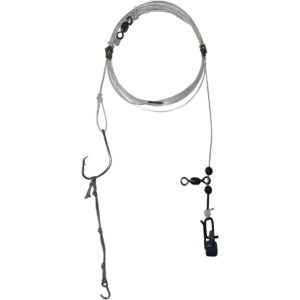
The Dongle Rig: The UK Shore Angler’s Secret Weapon
In recent years, a “new” rig has quietly revolutionised UK shore fishing, particularly for anglers targeting large specimens like rays, smoothhounds, and cod. Known as the Dongle Rig, it borrows a concept from carp fishing—the “hair rig”—and adapts it for the brutal environment of the British coast.
What is a Dongle Rig?
At its core, a Dongle Rig is a variation of the classic Pulley Rig. However, instead of threading your bait directly onto the hook (or using a two-hook Pennel setup), you attach the bait to a separate length of heavy braid or wire called the “dongle,” which hangs from the bend or shank of the hook.
This setup leaves the hook completely exposed and free from bait obstruction. When a fish sucks in the bait, the free-swinging hook takes hold—usually in the corner of the mouth (scissors)—providing a secure hook-up that facilitates easy unhooking and safe release.
How to Tie the Dongle Rig
Constructing a dongle rig requires a few specialized components, but the logic is simple. You are essentially building a standard Pulley Rig, but the hook snood terminates in a “Dongle” rather than just a knot.
Components Needed:
Hook: Size 3/0 to 6/0 Circle Hook (highly recommended) or J-Hook.
Dongle Material: 200lb–400lb heavy braided line (kevlar or Dyneema) OR nylon-coated wire.
Rig Body: 60lb–80lb mono.
Snood Line: 60lb–80lb mono.
Terminal Hardware: A small solid ring or “Dongle Ring,” a reliable bait clip (e.g., Gemini Splashdown or Breakaway Imp), and a swivel.
Step-by-Step Construction:
Create the Dongle:
Cut a length of your heavy braid (approx. 15cm).
Tie a small loop or tie on a small solid ring at one end (this will clip onto your bait clip).
Pass the other end through the eye of your hook (from back to front) or tie it to the bend of the hook, depending on preference.
Crucial Step: The length of the dongle must match the size of the bait you intend to use. A standard length is 80mm to 100mm from the hook bend to the bottom ring.
Secure the braid to the hook shank using a knotless knot or a strong whipping knot. Superglue the knot for security.
Build the Body:
Tie your main rig body line to a swivel (top).
Thread on a bead and a pulley swivel (which will hold your lead weight).
Tie the bottom of the rig body to your bait clip (e.g., Gemini Splashdown).
Connect the Snood:
Tie your hook snood line to the main swivel.
Tie the other end of the snood to the eye of the hook that now has the dongle attached.
The Result: You now have a pulley rig where the bait hangs on a “rope” (the dongle) below the hook, and the bottom of that rope clips onto the lead for casting.
Why & How to Change the Rig
The Dongle Rig is not a “one size fits all” solution. You must adapt the dongle element based on your target and bait.
1. Changing for Bait Size (The Length)
Standard (80mm): Perfect for Peeler Crab or generic fish baits. This keeps the bait compact and close to the hook.
Long (120mm+): Essential for large, elongated baits like whole Squid, Bluey wraps, or Sandeel cocktails. If you use a short dongle with a long bait, the bait will bunch up, or the hook will be masked.
Tip: Many anglers carry hooks pre-tied with different dongle lengths in their rig wallet and swap them out via a lure clip on the snood.
2. Changing for Species (The Material)
Braid Dongle: Best for Rays, Bass, and Cod. It is soft, feels natural to the fish, and is easy to wrap with bait elastic.
Wire Dongle: Essential for Tope and Smoothhounds. While smoothhounds aren’t “toothy” in the cutting sense, their crushing pads can abrade braid. Wire provides rigidity and prevents the dongle from collapsing during the cast.
When to Use It (and When NOT to)
Best Used For:
Clean to Mixed Ground: Ideal for sandy beaches or mixed shingle where you can let the fish run.
Catch & Release: If you are targeting Smoothhounds or Tope and want to return them alive, this rig is superior. The circle hook almost exclusively hooks them in the lip, avoiding deep-hooking (gut hooking).
Power Casting: Because the bait is clipped directly behind the lead via the dongle ring, the stress of the cast is taken by the heavy dongle braid, not the soft bait. This prevents the bait from flying off during a powerful pendulum cast.
Avoid Using When:
Targeting Small Fish: Flounders, dabs, or whiting will struggle with the large hardware.
Conger Eels: Congers tend to spin and back up; a dongle can sometimes result in foul-hooking or dropped runs with eels. A standard heavy mono snood is often better.
Why is it “Better”? (The Advantages)
The Dongle Rig offers three distinct mechanical advantages over a standard Pennel Pulley rig:
Superior Hook-Ups: On a standard two-hook Pennel rig, the bait often masks the hook points. On a dongle rig, the hook sits above the bait, completely naked. When a Ray or Cod sucks the bait in, the hook goes with it, but there is no bait clogging the gape of the hook.
Aerodynamics: By whipping the bait onto a stiff piece of braid/wire, you create a perfect “sausage” shape that aligns perfectly behind the lead. It casts like a bullet compared to a flapping Pennel rig.
Bait Security: On a standard rig, the force of the cast stretches the bait, often tearing it. On a dongle rig, the force travels through the braid dongle to the lead. Your bait arrives at the seabed in the same condition it left your hand.