

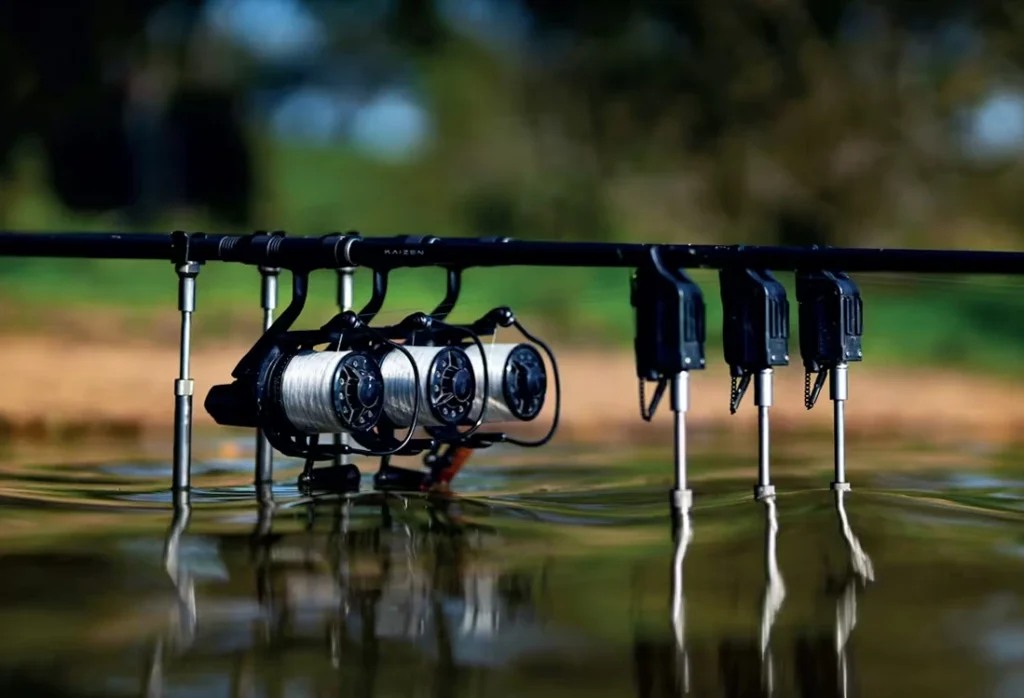
The Ultimate Carp Rod Buying Guide: Master Your Casting and Control
When you step onto the bank, your rods are the most significant investment in your arsenal. They are highly engineered instruments designed to propel a lead over a hundred yards into a dinner-plate-sized spot, and then protect a delicate hook-hold against a 30lb mirror carp diving for the nearest weed bed.
At Gerry’s Fishing, we’ve seen carp rod technology evolve rapidly, with the high-modulus carbons and advanced resins of 2026 offering unprecedented performance. This expanded guide dives deep into the technical mechanics of carp rods to help you navigate our Carp Rod Collection with total confidence.
1. Decoding Test Curves (TC): The Power of the Blank
The “Test Curve” is the metric that causes the most confusion. Technically, it is the amount of dead weight required to pull the rod tip into a 90-degree angle to the butt. Practically, it tells you how stiff the rod is, how much weight it can cast, and how much pressure you can apply to a fish.
2.75lb TC (The Soft Touch): * Ideal Lead Weight: 2oz to 3oz.
Best For: Small to medium day-ticket waters, margin fishing, and clear open water without snags. These rods offer incredible “feel” and act as a massive shock absorber, drastically reducing hook pulls at the landing net.
3.00lb to 3.25lb TC (The Modern Standard): * Ideal Lead Weight: 3oz to 4oz.
Best For: This is the sweet spot for 90% of UK carping. A 3.25lb rod has enough backbone to punch a heavy PVA bag into a headwind or hit 100+ yards, while still retaining enough flex in the tip to safely play fish.
3.50lb to 3.75lb+ TC (The Big Pit / Snag Specialists): * Ideal Lead Weight: 4oz to 5oz.
Best For: Extreme range casting on massive inland seas, or “hit and hold” situations in heavy weed or near submerged trees. These rods are incredibly stiff. If you use them at short range, you risk tearing the hook from the fish’s mouth due to the lack of give.
2. Rod Lengths: The Physics of Leverage
The length of your rod dictates your casting leverage and your maneuverability.
9ft to 10ft (Retractable & Stalking Rods):
These compact rods have revolutionized mobile angling. If you are fishing a narrow canal, navigating overgrown “jungle” swims, or dropping rigs from a boat, a 10ft rod is infinitely easier to handle than a traditional 12ft blank. They also pack down much smaller, making them ideal for anglers with smaller cars.
12ft (The Industry Standard):
A 12ft rod is the perfect compromise. It provides the necessary arc to generate fast tip speeds for long-distance casting, but isn’t so long that it becomes unwieldy when trying to net a fish by yourself.
12ft 6in to 13ft (The Distance Machines):
Designed for big gravel pits and tournament-style casting. The extra length creates a wider arc during the cast, translating to faster lead speeds and greater distances. However, to effectively “compress” (bend) a 13ft rod during a cast, you generally need to be taller, have longer arms, and possess excellent casting technique.
3. Rod Action: How the Blank Bends
If the Test Curve is the rod’s strength, the “Action” is its personality.
Parabolic / Through Action: The rod bends all the way down to the handle under pressure. This is a joy to play fish on, as lunges are absorbed effortlessly. However, because the rod bends so much, it “recovers” slowly, making it poor for distance casting.
Progressive / Middle-to-Tip Action: The rod bends mostly in the top half, but the power smoothly transfers down the blank as more pressure is applied. This is the ultimate all-rounder action, balancing casting potential with fish-playing safety.
Fast Action / Tip Action: The bottom two-thirds of the rod are incredibly stiff, with only the very tip flexing. This stores immense energy during a cast, recovering instantly to fire leads to the horizon. It requires a skilled hand and a loose reel clutch to avoid losing fish under the rod tip.
4. Hardware: Guides and Rings
The rings on your rod manage friction. The smoother the line passes through, the further you cast and the longer your main line lasts.
Butt Rings (40mm vs. 50mm): The butt ring is the first guide above the reel. If you use large “Big Pit” reels, the line comes off the spool in wide coils. A 50mm butt ring funnels these large coils smoothly, reducing “line slap” against the blank and adding yards to your cast. If you use smaller standard reels or fish at close range, 40mm guides are lighter and less prone to getting damaged in transit.
Anti-Frap Tip Rings: A modern essential. The metal frame of the tip ring is sloped backward. If the line billows during a forceful cast, it slides off the sloping frame rather than wrapping around it, saving you from a snapped rod tip.
Ring Material: Look for Zirconium or Silicon Carbide (SiC) inserts. They are incredibly hard, highly polished, and dissipate the heat generated by braided lines perfectly.
5. Handle Types and Reel Seats
Full Japanese Shrink Wrap: The most popular modern choice. It is an ultra-thin, rubberized coating that provides exceptional grip even when your hands are wet and covered in fish slime.
Full Cork: The traditionalist’s choice. High-quality cork is lightweight, warm to the touch in winter, and looks beautiful, though it requires occasional cleaning.
Abbreviated / Duplon (EVA): Features a stripped-back carbon handle with just a small grip at the base. It keeps the rod’s overall weight down and offers a sleek, minimalist aesthetic.
Reel Seats: Look for Fuji DPS or high-quality machined reel seats (usually size 18 or 20) to ensure large Big Pit reels lock down securely without wobbling under pressure.
6. Matching the Setup to the Water Depth and Size
| Water Type & Depth | Recommended Length & TC | Why it Works |
| Small Commercial / Margins (Up to 6ft deep) | 9ft – 10ft / 2.75lb | Precision casting under trees; soft enough to prevent hook pulls from fast-running fish at close quarters. |
| Medium Day Ticket (6ft – 12ft deep) | 12ft / 3.00lb – 3.25lb | Perfect for accurate casting to island margins or open water. Handles 3oz leads comfortably. |
| Large, Deep Gravel Pit (15ft+ deep) | 12ft or 13ft / 3.50lb+ | Deep water requires heavy leads (4oz+) just to feel the lead touch down cleanly. The stiff TC picks up line fast to set the hook at range. |
| Snaggy/Weedy Lakes | 12ft / 3.50lb | You need serious backbone to stop a fish dead in its tracks and bully it away from underwater hazards before it gets tethered. |
7. Featured Carp Rods at Gerry’s Fishing
Here is a closer look at some standout rods we highly recommend, complete with full specifications to help you make an informed choice.
Korda Kaizen Green Carp Rod
The Kaizen Green range brings Korda’s flagship rod technology down to an incredibly accessible price point, offering custom-build aesthetics with off-the-shelf reliability.
This rod features a fast-taper profile, meaning the power is generated from the butt section while the tip remains highly responsive. This makes it an exceptional casting tool for anglers who want to hit longer distances without needing the technique of a tournament caster. It’s the perfect primary rod for medium to large day-ticket waters where hitting specific spots at 80-100 yards is critical for a bite.
Specifications:
Length: 12ft (3.6m)
Test Curve: 3.00lb
Blank Material: High-modulus carbon with a matte, non-glare finish
Guides: Lightweight stainless steel sea-guide rings
Butt Guide: 50mm
Tip Guide: Anti-frap ceramic
Reel Seat: Quality DPS style
Handle: Breathable Japanese shrink wrap with flared butt
Action: Fast-taper / Progressive
Sonik VaderX RS Carp Rod
The “RS” (Evolved) version of the award-winning VaderX is widely regarded as one of the best value-for-money rods on the market today.
Sonik has refined the carbon layup to increase the recovery speed of the blank, ensuring your casts are straighter and more accurate. The VaderX RS is a fantastic workhorse rod. It is rugged enough to withstand the abuses of regular angling, making it ideal for newcomers to the sport or those looking to upgrade their entire three-rod setup without breaking the bank. The 10ft version is particularly brilliant for stalking or tight swims.
Specifications:
Length: 10ft (3.0m)
Test Curve: 3.00lb
Blank Material: Slim, lightweight armoured carbon fibre
Guides: Double-leg M-SERIES DL black guides
Butt Guide: 40mm
Tip Guide: Anti-frap ceramic ring
Reel Seat: 17mm black DPS (houses all big pit reels)
Handle: Slim Japanese shrink wrap
Action: Medium-Fast
Nash Scope Cork Carp Rod
Nash’s Scope range pioneered the short-rod revolution with their innovative retractable butt section, allowing a 9ft rod to pack down to an astonishingly small size.
The Scope Cork combines this modern tactical advantage with classic aesthetics. It is the ultimate tool for the mobile angler. If your fishing involves keeping gear to a minimum, sneaking into tight spots between bushes, or dropping rigs via a bait boat, this rod is unmatched. Despite its short length, the blank holds immense reserves of power, easily capable of subduing 30lb+ fish in weedy margins.
Specifications:
Length: 9ft (2.7m)
Packdown Length: 44 inches (112cm)
Test Curve: 3.25lb
Blank Material: High-performance carbon blend
Guides: Minima reverse-flightings
Butt Guide: 40mm
Tip Guide: Anti-frap
Reel Seat: Fuji matte black DPS
Handle: Full premium cork
Action: Parabolic / Through-action
8. Detailed Frequently Asked Questions
Q: Does a higher Test Curve mean I can cast further?
A: Not necessarily. A higher test curve (like 3.5lb) can cast heavier weights further, but only if you have the physical strength and technique to bend the rod fully during the cast. If you cannot compress a 3.5lb rod, you will actually cast further with a softer 3.0lb rod that loads easily under your natural casting stroke.
Q: Why do some rods have carbon line clips?
A: A line clip on the rod blank allows you to trap the line securely above the reel, ensuring the line enters the electronic bite alarm at a sharp angle. This drastically improves the sensitivity of the alarm, giving you better bite indication for “dropbacks” (when a fish swims towards you).
Q: What is the difference between 1k, 2k, and 3k carbon weaves?
A: This refers to the carbon fibre wrap used on the outside of the blank. “1k” means there are 1,000 filaments per “tow” (the woven strand). 1k is a very tight, fine weave, while 3k is wider and more prominent. While these weaves add a small amount of hoop strength to prevent the blank from crushing, they are largely aesthetic finishes applied over the core unidirectional carbon.
Q: Should I buy a Spod rod or just use an old carp rod?
A: You should definitely invest in a dedicated Spod rod. A fully loaded large Spomb can weigh over 6oz. Casting this repeatedly with a standard 3.0lb carp rod will eventually soften the blank or cause it to snap. Spod rods (usually 4.5lb to 5.5lb TC) are built specifically to withstand this aggressive, heavy casting.
Q: How should I store my carp rods when not in use?
A: Always loosen the clutch on your reels to release tension. Store the rods in a padded holdall in a dry place with a consistent temperature. Avoid leaving them in a hot car or a damp shed, as extreme temperatures can degrade the resin in the carbon, and moisture can cause the guides to rust or the cork handles to rot.
Gear Up for Your Next Session
Getting the right rod is all about matching the tool to the task. Take the time to consider where you fish the most and what style of angling brings you the most joy