





Your payments are secure with our private security network.
Your orders are shipped seamlessly between countries.
We are happy to take returns for new items for up to 30 days.
Expert advice on all types of fishing situations & tackle.
Welcome to the definitive guide to continental sea fishing rods. At Gerry’s Fishing, we have witnessed the dramatic shift in the UK shore angling scene over the last two decades. What started as a niche Mediterranean style of fishing has become a dominant force on British beaches.
Whether you are a seasoned match angler looking for that extra edge in bite detection or a leisure angler wanting to cast further with less physical strain, understanding the nuances of continental rods is essential.
A “Continental” rod refers to a style of sea fishing rod originally developed for the calmer, tideless waters of the Mediterranean (Spain, Italy, and France). Unlike the traditional British “beachcaster,” which was designed to heave heavy leads into massive Atlantic swells using multipliers, the continental rod is built for finesse, distance, and use with fixed-spool reels.
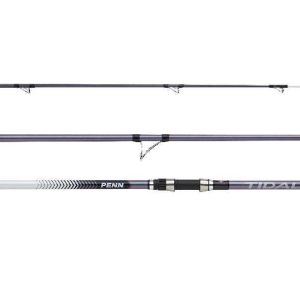
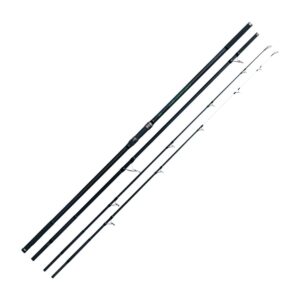
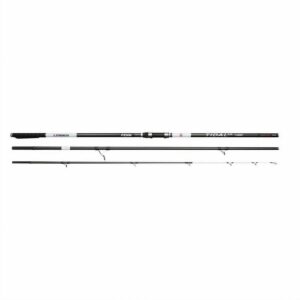
Typically, these rods are longer than their British counterparts, usually ranging from 4.2 meters (14ft) to 5 meters (16ft 4in). They are almost exclusively three-piece designs, making them incredibly easy to transport. The primary goal of a continental rod is to provide the angler with the ability to cast significant distances using a simple overhead or off-the-ground cast, while maintaining unparalleled bite detection through highly sensitive tips.
The debate between traditional UK rods and continental styles often comes down to the “Ground vs. Technique” argument.
The Traditional UK Beachcaster: Traditionally, a UK rod is 12ft to 13ft 6in, stiff, and designed to be used with a multiplier reel. These rods are built to withstand the rigours of “Pendulum” casting and are often used in heavy kelp or over rough rock marks where you need to “bully” a fish to the surface. They are heavy, require significant physical strength to “load” the blank, and often lack the sensitive bite detection required for smaller species.
The Continental Rod: The continental rod is the “sports car” of the sea fishing world. Built from high-modulus carbon, these rods are incredibly light. Because they are longer, they create a massive arc during the cast, which generates high lead speed without the need for a complex and potentially dangerous pendulum cast. They are designed for fixed-spool reels loaded with thin braids or low-diameter monofilament, allowing for frictionless casting.
To choose the right rod for your fishing, you need to understand the technical specifications that differentiate one model from another.
This is perhaps the most important choice when browsing our selection at Gerry’s Fishing.
Tubular Tips: These are hollow all the way to the tip-ring. They are generally stiffer and more powerful. If you are fishing in heavy seas, targeting larger species like Ray or Smoothhound, or need to cast heavier leads (6oz+), a tubular tip is the better choice. It won’t “fold” in a strong tide and offers more backbone during the cast.
Hybrid (Solid) Tips: A hybrid tip features a solid carbon splice joined to the tubular blank. This results in a tip that is incredibly thin and sensitive—often referred to as a “spliced-in” tip. These are the gold standard for match fishing. They allow you to see the tiny rattles of a Whiting or Flatfish at 100 yards, and because the tip is so soft, the fish feels zero resistance when it takes the bait, leading to better hook-up rates.
Because continental rods are designed for fixed-spool reels, the guide layout is very different from a multiplier rod.
LC (Low Rider) Guides: You will often see these on entry-to-mid-level continental rods. They have a small diameter and are designed to “tame” the coils of line coming off a fixed-spool reel quickly, reducing wind knots.
K-Series Guides (Fuji K-Guides): These are the premium choice. They feature a unique tilted frame that is specifically designed to be “tangle-free.” When using thin braids, which can easily wrap around a guide during a powerful cast, K-guides allow the loop to shed itself naturally.
Start Guide Position: Notice that the first guide (the butt guide) is much further away from the reel seat and often larger than on a multiplier rod. This is to accommodate the large loops of line “spiralling” off a fixed-spool reel.
4.2m (13ft 9in): This is the “standard” length. It offers a great balance between casting distance and ease of use. It is ideal for anglers moving from traditional rods who don’t want something that feels too unwieldy.
4.5m (14ft 9in): Currently the most popular length in the UK. The extra length allows for longer traces (essential for targeting wary fish) and provides more leverage to launch a lead.
5m+: These are specialist tools. They are used primarily for “walking” the lead in light tides or when you need to keep your line high above the crashing surf to avoid weed and wave pull.
When you message us about a specific product, we provide deep-dive specifications. Here are examples of the types of rods we carry in this category:
The Tronixpro Competition Performance
Length: 4.2m / 4.5m
Casting Weight: 100g – 200g
Guides: Fuji Titanium K-Guides
Reel Seat: Fuji DPS
Tip: Hybrid
Best Use: High-end match fishing on clean to mixed ground. The lightweight Fuji Titanium guides make this one of the fastest-recovering blanks on the market.
The Vercelli Enygma Vento
Length: 4.2m / 4.5m
Casting Weight: 100g – 200g (Optimum 125g + Bait)
Guides: Fuji LC Low Rider
Tip: “Competition” Hybrid Tip
Best Use: A fantastic all-rounder for the UK angler. It has enough backbone to handle a 5oz lead in a moderate sea but retains that signature Vercelli sensitivity.
The Akios Airspeed Surf
Length: 4.35m
Casting Weight: 112g – 225g
Guides: Fuji Alconite KWAG
Reel Seat: Fuji DPS
Tip: Spliced Carbon Hybrid
Best Use: Powerful continental fishing. This rod is slightly stiffer than many Spanish designs, making it better suited for the rugged conditions of the UK’s North East and North West coasts.
We don’t just sell rods; we fish with them. Our staff includes international match anglers and local experts who have tested these blanks in every condition imaginable—from the flat calms of the South Coast to the raging tides of the Bristol Channel. When you buy from us, you are getting a rod that has been vetted for quality, durability, and performance.
Q: Can I use a multiplier reel on a continental rod? A: Generally, no. Continental rods are designed with a specific guide spacing and “spine” alignment for fixed-spool reels. Using a multiplier will result in the line rubbing against the blank and poor casting performance. Furthermore, most continental rods feature a fixed reel seat in a high position, which is uncomfortable for multiplier use.
Q: Do I need to learn a Pendulum cast to get the distance? A: No. In fact, you should not pendulum cast a continental rod unless the manufacturer explicitly states it is rated for it. These rods are designed for a “Brighton Cast” or a simple “Off-the-Ground” (OTG) cast. The length of the rod does the work for you.
Q: Are continental rods only for “clean” ground? A: While they excel on sand and shingle, many modern continental rods are surprisingly powerful. You can use them on “mixed” ground (areas with some stones and light weed). However, for heavy kelp or snag-ridden rock marks, a traditional stiff UK beachcaster is still the better tool.
Q: What line should I use? A: To get the most out of these rods, we recommend using a high-quality, low-diameter monofilament (0.28mm to 0.35mm) or a dedicated sea fishing braid (usually 20lb to 40lb). Always use a tapered shock leader to ensure safety during the cast.
Q: Why are they three pieces instead of two? A: The three-piece design allows for more precise “tapering” of the blank. It allows the manufacturer to make the butt section very stiff, the mid-section progressive, and the tip incredibly fine. It also makes them much easier to fit into a standard car.
Q: Is a hybrid tip too soft for big fish? A: Not at all. The “hybrid” part is only the last few inches of the tip. Once that tip bends, you quickly reach the “power” part of the blank. You can still land large Rays and Hounds on a hybrid tip; the tip simply acts as a visual indicator, while the rest of the rod provides the pulling power.