

Your payments are secure with our private security network.
Your orders are shipped seamlessly between countries.
We are happy to take returns for new items for up to 30 days.
Expert advice on all types of fishing situations & tackle.
Welcome to the Gerry’s Fishing definitive guide to jig heads and weedless hooks. If soft plastic lures are the engine of modern predator fishing, then the hook is the chassis. Without the right connection, your lure won’t swim correctly, and more importantly, you won’t hook the fish of a lifetime.
At Gerry’s, we have curated the most comprehensive selection of terminal tackle for lure fishing in the UK. From micro-jigs for ultra-light street fishing to heavy-duty “beast” hooks for monster pike, we provide the hardware that converts subtle taps into solid hook-ups.
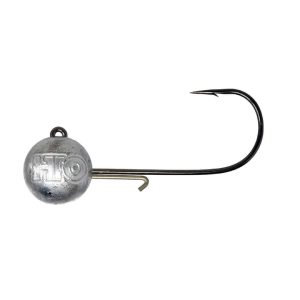
A jig head is simply a hook with a weight (usually lead or tungsten) molded onto the shank near the eye. This provides the weight needed to cast and allows the lure to sink to the target depth.
The shape of the head determines how the lure behaves in the water:
Round Head: The “all-rounder.” It offers a consistent sink rate and is perfect for most vertical and cast-and-retrieve styles.
Football/Rugby Head: Wide and stable. These are designed to sit on the bottom without tipping over—ideal for “crayfish” style baits.
Bullet Head: Streamlined for cutting through current or heavy weed.
Dart/Triangle Head: These have flat sides that cause the lure to “dart” side-to-side when twitched—deadly for aggressive perch and zander.
At Gerry’s, we emphasize matching the hook to the lure body. If the hook is too long, it will stiffen the lure and kill the action. If it’s too short, you’ll miss bites.
Size 4 – 1: Perfect for 2″ to 3″ micro-lures (Perch/LRF).
Size 1/0 – 4/0: The standard for 4″ to 5″ shads.
Size 6/0 – 10/0: Heavy-duty hooks for 7″ to 10″ pike lures.
If you are fishing in “snaggy” areas—reeds, lily pads, or sunken timber—a standard jig head will snag almost instantly. This is where weedless hooks (often called Offset or EWG hooks) are essential.
These feature a “crank” near the eye. The hook point is tucked flush against or slightly inside the back of the lure. When a fish strikes, the soft plastic collapses, exposing the hook point.
Weighted Offset Hooks: These feature a small lead weight on the belly of the hook. This acts as a keel, keeping the lure upright and allowing it to “flutter” down naturally.
Unweighted Hooks: Best for “top-water” soft plastics or fishing ultra-shallow over the tops of weed beds.
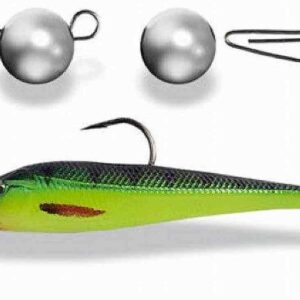
One of our top-selling items at Gerry’s. This is a “removable” weight system. A wire clip slides out of a round weight; you attach your weedless hook to the clip and slide it back in.
The Benefit: It gives the lure total freedom of movement. Because the hook isn’t “fused” to the weight, the lure can wobble and shimmy much more enticingly than on a standard jig.
When selecting your terminal tackle, look for these professional-grade specs:
| Feature | Specification | Benefit |
| Material | Tungsten | Higher density than lead; smaller profile for the same weight; better “feel” on the bottom. |
| Coating | Black Nickel / BN | High corrosion resistance for salt or brackish water. |
| Point | Chemically Sharpened | Needle-sharp out of the packet; essential for the bony mouths of Zander and Pike. |
| Wire Gauge | Fine vs. X-Strong | Fine wire for light-line perch (easy penetration); X-Strong for pike to prevent the hook straightening. |
Savage Gear Ball Jigheads
Hook: Ultra-sharp forged carbon steel.
Features: Pro-peg body holder (a small wire barb that stops your lure from sliding down the hook).
Best Use: General-purpose shad fishing for all UK predators.
BKK Titan Diver (Weighted Weedless)
Hook: Super Slide coating for instant penetration.
Features: Interchangeable lead weights and a lead-spring “corkscrew” to hold the lure head securely.
Best Use: Heavy-duty weedless fishing for pike in lily pads or thick weed.
VMC 7316 Cheburashka Hook
Design: Large eye to allow maximum movement on a Cheb weight.
Features: Vanadium steel construction.
Best Use: Modern perch fishing on canals and rivers.
Q: What weight jig head should I use?
A: A good rule of thumb for the UK is 1g of weight for every 1m of depth. If it’s windy or the current is strong, increase the weight to ensure you can still feel the “thump” of the lure hitting the bottom.
Q: Do I need to “strike” harder with weedless hooks?
A: Yes. Because you have to “pop” the hook point through the plastic body of the lure before it hits the fish, a slightly firmer, more deliberate strike is required compared to an open-point jig head.
Q: Why use Tungsten over Lead?
A: Tungsten is much harder than lead. When it hits a rock or gravel, it sends a “ping” up your braid that you can feel through the rod. It’s also more environmentally friendly and has a much smaller visual profile.
Q: What is a “Lure Keeper” or “Bait Holder”?
A: It’s the small barb or wire on the shank of the jig head. Its job is to grip the soft plastic and stop it from being pulled down the hook by weed or small fish “nipping” at the tail.
Q: Can I use these for sea fishing (LRF)?
A: Absolutely. Our jig heads are perfect for Light Rock Fishing (LRF). Just ensure you rinse them in fresh water after use, as salt can eventually dull even the best chemically sharpened points.
Q: How do I know if my hook is sharp enough?
A: Use the “fingernail test.” Lightly drag the hook point across your thumbnail. If it slides, it’s blunt. If it “digs in” and leaves a tiny scratch with no pressure, it’s sharp enough to fish.
At Gerry’s Fishing, we know that the small details make the big differences. If you aren’t sure which hook size fits your new pack of lures, bring them into our Morecambe showroom and we will help you “rig up” perfectly