




Your payments are secure with our private security network.
Your orders are shipped seamlessly between countries.
We are happy to take returns for new items for up to 30 days.
Expert advice on all types of fishing situations & tackle.
Welcome to the Gerry’s Fishing guide to Bass and Estuary rods. Whether you are wading through the surf of a storm-beaten beach or navigating the quiet, brackish reaches of a local tidal river, having the right rod is the difference between a clumsy cast and a perfectly placed bait.
Bass are the UK’s premier saltwater sporting fish. They require a rod that is light enough to hold for hours, yet powerful enough to stop a “lunker” from diving into a snag. At Gerry’s, we have curated a selection that covers everything from light estuary “scratching” to heavy-duty rock hopping.
Unlike a standard 12ft-14ft beachcaster, a Bass or Estuary rod is a specialized tool. Typically ranging from 11ft to 12ft 6in, these rods are designed for a more active style of fishing.
Bass Rods: Usually rated to cast 2oz to 4oz. They feature a “steely” action with plenty of power in the lower sections to cope with the surge of a big fish in the surf.
Estuary Rods: Often slightly lighter (rated 1oz to 3oz). These are designed for finesse, using lighter leads in slower-moving water to target Flounder, Mullet, and schoolie Bass.
Weight: They are significantly lighter, allowing you to “wander and wallow”—moving along the beach or bank looking for fish without fatigue.
Sensitivity: The tips are much finer, allowing you to feel the “tick-tick” of a Bass’s inquisitive take or the gentle pull of a Flounder in the tide.
Accuracy: The shorter length makes them much easier to use when “flicking” a bait under a pier, against a harbour wall, or into a specific gully.
Supple Tips: Essential for estuary work. A soft tip allows a fish to take the bait without feeling immediate resistance, which is vital for wary species like Mullet or late-season Flounder.
Power Tips: For “True Bass” rods, the tip needs more backbone to prevent it from “folding” in heavy surf or when using a larger bait like a whole peeler crab or a big squid strip.
Most modern Bass rods are rung for fixed-spool reels. Look for K-Series guides which help prevent wind knots—a common problem when casting light baits into a headwind. High-quality ceramic inserts (like Fuji Alconite) are a must to protect your line from the abrasive nature of saltwater and sand.
11ft: The “Short” Bass rod. Perfect for close-range work, rock marks, or fishing from a boat.
11ft 6in to 12ft: The “All-Rounder.” This is the sweet spot for most UK anglers, offering enough length to cast a decent distance while remaining manageable.
12ft 6in: The “Long” Bass rod. Ideal for big surf beaches where you need to keep your line high above the waves to avoid weed and “pull.”
At Gerry’s Fishing, we stock brands that understand the nuances of the UK coastline. Here are some of our top picks:
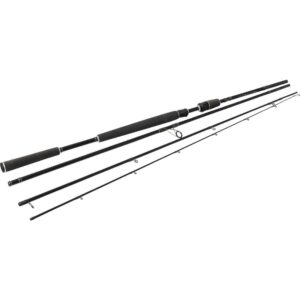
Vass-Tex “The Bass” Rod Designed in conjunction with some of the UK’s top Bass anglers.
Length: 11ft 8in
Casting Weight: 2oz – 5oz
Guides: Genuine Fuji K-Guides
Best Use: The ultimate “surf” bass rod. It has a lightweight, slim blank but handles a 4oz lead with ease.
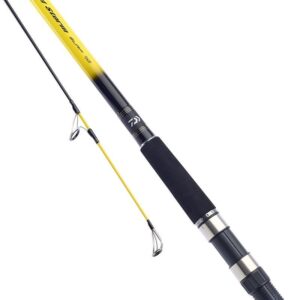
Tronixpro Banzai Bass A fantastic entry-to-mid-range rod that punches well above its weight.
Length: 11ft 8in
Casting Weight: 2oz – 4oz
Build: 2-piece high-modulus carbon.
Best Use: Great for “roving” the coast. It’s light, responsive, and incredibly value-for-money.
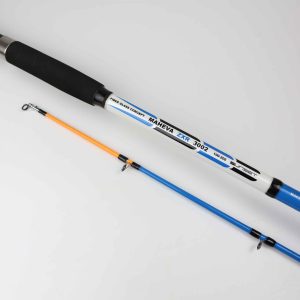
Anyfish Anywhere Estuary Rod The gold standard for light shore work.
Length: 12ft
Casting Weight: 1oz – 3oz
Action: Incredibly sensitive tip with a surprisingly powerful butt.
Best Use: Estuary fishing for Flounder and schoolie Bass. It’s a joy to play fish on.
Q: Can I use a lure with these rods? A: While these rods are primarily designed for bait fishing (using lead weights), they can handle very large lures (40g+). However, if you are looking to throw standard 10g-30g lures all day, you should look at our dedicated Lure Rod section for something lighter and shorter.
Q: What is the best lead weight for Bass fishing? A: Most Bass anglers find that a 3oz or 4oz “grip lead” is the perfect balance. It’s heavy enough to hold the bottom in a surf but light enough to let the rod’s sensitivity shine through.
Q: Should I use braid or mono? A: For estuary fishing, many prefer monofilament (12lb-15lb) because it is more abrasion-resistant against barnacles and rocks. However, for distance casting on clean beaches, braid offers superior bite detection and casting range.
Q: Is a 12ft rod too long for a river? A: Not for a tidal estuary. The extra length is useful for reaching past the mudbanks and keeping your line clear of the “wrack” and debris that often floats downstream on a rising tide.
Q: What is a “Schoolie” Bass? A: This is a term used for juvenile Bass, typically under the legal retention limit. They often shoal in massive numbers in estuaries. A light Estuary rod makes catching these smaller fish fantastic fun.
Q: How do I clean my rod after estuary fishing? A: Even though estuaries are “brackish” (a mix of salt and fresh water), the salt content is still high. Always rinse your rod thoroughly with fresh tap water, paying close attention to the reel seat and the inside of the guides.
At Gerry’s Fishing, we are passionate about the sport. If you are planning a trip to the Luene or the Kent estuary, or heading down to the rocky marks of the South West, come in and see us. We’ll help you balance your rod with the right reel and line to ensure you have the best chance of landing that silver bar of a Bass