

Your payments are secure with our private security network.
Your orders are shipped seamlessly between countries.
We are happy to take returns for new items for up to 30 days.
Expert advice on all types of fishing situations & tackle.
Welcome to the Gerry’s Fishing ultimate guide to baitcasting reels. If you are targeting pike, zander, or perch in UK waters, the baitcaster is often the most efficient and powerful tool in your arsenal. While the fixed-spool reel is the “jack of all trades,” the baitcasting reel is the specialist machine designed for accuracy, lure control, and handling the relentless stress of heavy predator fishing.
At Gerry’s, we have spent decades testing the world’s best predator tackle. Whether you are throwing tiny crankbaits for perch or massive 10-inch shads for specimen pike, understanding the mechanics of a baitcaster is the key to unlocking better results on the water.
A baitcasting reel (often simply called a “baitcaster”) is a multiplier reel designed specifically for casting lures. Unlike a fixed-spool reel, where the line uncoils off a stationary spool, a baitcaster features a revolving spool. When you cast, the weight of the lure pulls the line, which in turn rotates the spool.
Because the spool rotates, the line comes off in a straight line, directly in line with the rod guides. This significantly reduces line twist and allows for a level of “feel” and “thumb control” that is impossible to achieve with a standard spinning reel.
For many UK anglers, the fixed-spool reel is the starting point. So, why should a predator angler consider a baitcaster?
Casting Accuracy: Because your thumb rests directly on the spool during the cast, you can “feather” the line. This allows you to stop a lure mid-air with millimetre precision, dropping a jerkbait perfectly alongside a reed bed or under an overhanging tree.
Power and Torque: The winch-like design of a baitcaster provides significantly more cranking power. When a 20lb pike dives into a weed bed, a baitcaster allows you to exert direct pressure without the “flex” often found in spinning reel rotors.
Lure Contact: With the reel sitting on top of the rod, the line has a direct path to your hand. You can feel the vibration of a spinnerbait blade or the lightest “tap” of a zander through the reel seat and the spool itself.
Handling Heavy Lures: Constant casting of 100g+ lures will eventually wear out the bail arm and line roller of a spinning reel. Baitcasters are built for this repetitive heavy-duty work.
When browsing our collection at Gerry’s, you will notice two distinct shapes.
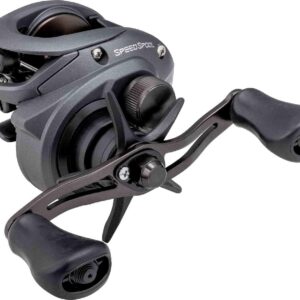
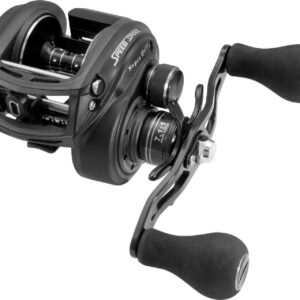
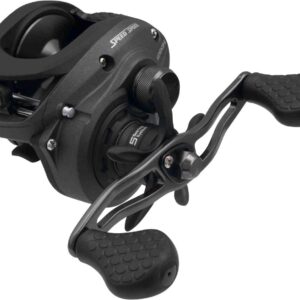
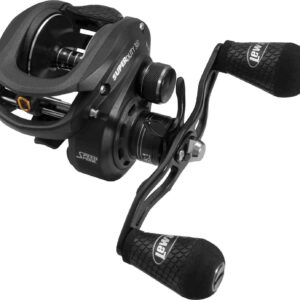
These are the most popular choice for modern lure fishing. They are designed to sit low on the rod, allowing you to “palm” the reel (wrapping your hand around both the reel and the rod).
Pros: Extremely ergonomic, lightweight, and perfect for “active” fishing where you are casting hundreds of times a day.
Best For: Jerkbaits, soft plastics, and general lure work.
These look like traditional “multipliers” but are scaled down for casting. They have a larger spool capacity and a more robust frame.
Pros: Massive line capacity and incredible durability. They often feature larger gears for maximum winching power.
Best For: Trolling, casting very large “pounder” baits, or fishing in heavy cover where you need maximum strength.
The biggest hurdle for new baitcasting anglers is the “overrun” or “birds’ nest.” To prevent the spool from spinning faster than the lure is travelling, baitcasters use braking systems.
Magnetic Brakes: These use magnets to create resistance on the spool. They are usually adjusted via a dial on the outside of the reel. They are most effective at the end of the cast when the lure slows down.
Centrifugal Brakes: These use small weights (pins) inside the side plate. As the spool spins fast at the start of the cast, centrifugal force pushes these weights outward against a friction ring. These are excellent for preventing overruns during the initial high-speed “launch” phase of the cast.
The Mechanical Brake (Spool Tension): This is the small knob next to the handle. It applies physical pressure to the spool shaft. At Gerry’s, we recommend tightening this until your lure slowly drops to the floor when you release the thumb bar—this is the “safety net” for every cast.
Baitcasters come in various gear ratios (e.g., 5.4:1, 7.1:1, 8.5:1).
Low Ratio (5.1:1 to 6.3:1): High torque. Best for lures with a lot of resistance, like large-bladed spinnerbaits or deep-diving crankbaits.
High Ratio (7.1:1 and above): High speed. Best for “picking up” slack line quickly when jerkbaiting or when you need to burn a lure back to the boat to trigger a follow.
At Gerry’s Fishing, we stock the industry leaders. Below are detailed specifications for some of our top-performing models.
Shimano Tranx (300 & 400 sizes)
The “Gold Standard” for heavy pike fishing. The Tranx is built like a tank but handles like a sports car.
Coreprotect: Provides water resistance without creating a heavy rotation feeling.
Hagane Body: High-rigidity metal body that eliminates flexing under load.
X-Ship: Supports the pinion gear on both ends with bearings for incredible smoothness.
Specifications (301 Model):
Gear Ratio: 5.8:1
Max Drag: 10kg
Weight: 330g
Bearings: 5+1
Best Use: Throwing the heaviest lures in your box—Big McRubbers, Miuras Mouse, and giant shads.
Abu Garcia Revo Beast
Abu Garcia has a long heritage in pike fishing, and the Revo Beast is the pinnacle of their low-profile range.
X2-Cräftic Alloy Frame: For corrosion resistance and strength.
Power Stack Carbon Matrix Drag: One of the most powerful drag systems in its class.
Infini Brake System: Combines magnetic and centrifugal braking for ultimate adjustability.
Specifications:
Gear Ratio: 5.8:1 or 7.3:1
Max Drag: 14kg (30lb)
Weight: 270g
Bearings: 7+1
Best Use: All-round pike fishing. It is light enough for all-day use but has the drag power to stop a bus.
Daiwa Tatula TWS 300
Featuring Daiwa’s revolutionary T-Wing System (TWS), this reel offers unparalleled casting distance.
T-Wing System: The T-shaped line guide reduces friction during the cast, allowing the line to exit the spool more freely.
Magforce Z: Magnetic braking that adjusts based on the spool’s rotational speed.
Utd Drag: Ultimate Tournament Drag for smooth, stutter-free performance.
Specifications:
Gear Ratio: 6.3:1 / 7.1:1 / 8.1:1
Max Drag: 13kg
Weight: 325g
Bearings: 7+1
Best Use: Precision casting. If you need to hit a far-off lily pad with a weedless frog or soft plastic, this is the reel.
Q: Why do I keep getting “birds’ nests” (overruns)?
A: This usually happens because the spool is spinning faster than the lure is moving through the air. This can be caused by casting into a headwind, using a lure that is too light, or having your brakes set too “loose.” Start with your brakes on maximum and gradually wind them back as you get comfortable.
Q: Can I use monofilament on a baitcaster?
A: Yes, but for pike fishing, we almost exclusively recommend 8-strand braid (usually 50lb to 80lb test). Braid has no stretch, which is vital for setting the hook in a pike’s bony mouth, and its lack of “memory” makes it much easier to manage on a baitcasting spool.
Q: What is the “Thumb Bar”?
A: Instead of a bail arm, baitcasters have a bar (usually located behind the spool) that you press with your thumb to disengage the gears. Once pressed, the spool is free to rotate. Turning the handle automatically re-engages the gears.
Q: Do I need a special rod for a baitcaster?
A: Yes. Baitcasting rods are designed with the guides and reel seat on the top. They also feature a “trigger grip” on the underside of the reel seat, which allows you to grip the rod securely while palming the reel.
Q: Are baitcasters suitable for light lures?
A: Traditional baitcasters struggle with lures under 7g. For very light fishing (Perch/LRF), you would need a “BFS” (Bait Finesse System) reel, which features a lightweight, shallow spool. Most of the reels in our predator category are designed for lures from 15g up to 200g+.
Q: How do I maintain my baitcasting reel?
A: After every session, especially if fishing in brackish water, wipe the reel down with a damp cloth. A drop of high-speed oil on the spool bearings and a small amount of grease on the main gears once a season will keep the reel performing like new. Gerry’s also stocks dedicated reel cleaning kits for those who want to do it themselves.
Q: What does “Left Hand Wind” mean in baitcasters?
A: In the UK, most fixed-spool anglers use their left hand to wind. Therefore, you should look for “Left Hand Wind” (often denoted by a ‘1’ in the model number, like Shimano 301). A “Right Hand Wind” reel requires you to cast with your right hand and then switch the rod to your left hand to wind with your right—a common practice in the USA but less common here.
If you are ready to make the leap into baitcasting or want to upgrade your current predator setup, browse our full range online. Our team at Gerry’s Fishing is always on hand to provide expert advice on matching the right reel to your rod and target species. Stop by the shop or call us for a chat—we live and breathe predator fishing